
Choosing the right alpine touring ski boot depends on balancing weight, flex, and binding compatibility with your specific skiing habits. Whether you prioritize a soft flex for comfort or a stiff shell for technical performance, the right boot enhances both the climb and the descent.
This comparison examines eight distinct options, ranging from hybrid boots with broad binding compatibility to lightweight, dedicated backcountry models. By looking at last width, range of motion, and shell materials, you can identify the boot that aligns with your goals and setup.
Our 3 picks for different needs

SCARPA Men's 4-Quattro GT
The 4-Quattro GT offers a 110 flex and is described as the warmest and roomiest hybrid, making it ideal for skiers prioritizing comfort on long days.
Read the details
SCARPA Men's F1 LT
The F1 LT is the lightest weight option listed, featuring a 72-degree range of motion and BOA fit for skiers focused on uphill efficiency.
Read the details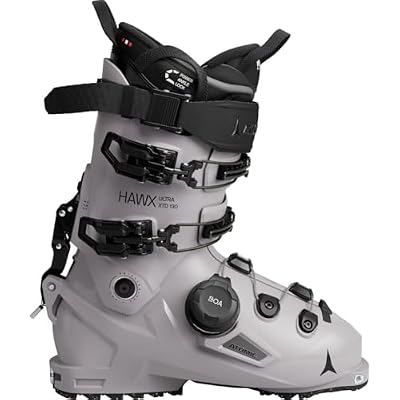
Atomic Hawx Ultra XTD 130 BOA
The Atomic Hawx Ultra XTD 130 features a 98mm last and 130 flex, suiting skiers who prefer a precise, narrow fit for aggressive freeride touring.
Read the detailsAll products, in detail

SCARPA Men's 4-Quattro SL 120 Flex
The 4-Quattro SL is a hybrid boot designed for versatility across resort and backcountry conditions. It features a Pebax R-New shell made from plant oil, which retains performance in cold weather and offers energy transfer. The boot includes a GripWalk sole for reliable grip on slick surfaces and an Intuition 4Pro Flex SL liner that is warm and custom moldable.
With a 120 flex and 61-degree range of motion, it suits skiers who want a stiff construction for varied terrain. The binding compatibility list includes GripWalk, TLT, and AT systems, making it a flexible choice for different setup preferences.
- Pebax R-New shell made from plant oil
- 120 flex with 61-degree range of motion
SCARPA Men's 4-Quattro GT
This boot is described as SCARPA's warmest and roomiest hybrid option, prioritizing comfort for longer days. It features a 110 flex, which is the softest in the 4-Quattro series, designed for versatile performance. The Intuition 4Pro Flex GT liner pairs with a high-performance PU shell to provide warmth.
The Speed Lock 4 mechanism allows for secure ski mode and a comfortable range of motion in walk mode. It is compatible with AT, TLT, and alpine bindings featuring GripWalk, offering broad compatibility for skiers who split time between resort and backcountry.
- 110 flex with 101mm last
- Compatible with AT, TLT, and GripWalk alpine bindings

SCARPA Men's Maestrale
The Maestrale is positioned as a benchmark for all-around touring performance, balancing reliability on the skin track with descent capability. It uses a Pebax R-New shell and cuff with a carbon core to achieve a solid 110 flex. The Speed Lock MLT ski/walk mode lever is designed for easy use with gloves and reduces snow buildup.
The Pro Flex Touring liner is warm, lightweight, and customizable for a precise fit. With a 101mm last and 60-degree range of motion, it is a strong choice for skiers seeking a balanced, environmentally friendly construction.
- Pebax R-New shell with carbon core
- 110 flex with 60-degree range of motion

SCARPA Men's Maestrale RS
A redesigned version of the Maestrale, this boot offers a comfier feel with an environmentally friendly construction. It features a Grilamid Bio shell and Pebax R-New cuff with carbon cores, optimizing power transfer and torsional rigidity. The 125 flex provides a stiffer response for the descent.
The Speed Lock MLT lever facilitates fast transitions, while the Intuition Pro Flex Performance liner offers warmth and customizability. With a 102mm last and 61-degree range of motion, it suits skiers who want a slightly wider fit and higher stiffness than the standard Maestrale.
- Grilamid Bio shell with carbon cores
- 125 flex with 102mm last
SCARPA Men's F1 LT
The F1 LT is SCARPA's lightest weight alpine touring boot, combining backcountry performance with uphill capabilities. It features a Carbon Grilamid LFT shell and a 3D Lambda frame with raised ribs for strength and responsiveness. The BOA Fit System uses lightweight dials and aircraft-grade stainless steel laces for a secure fit.
With a 100 flex and 72-degree range of motion, it is designed for long days and steep lines. The binding compatibility is listed as TLT, making it a specialized choice for skiers prioritizing weight savings and technical performance.
- 2 lbs 2.9 oz weight (half pair, size 27)
- 72-degree range of motion with BOA Fit System

SCARPA Men's F1
The F1 is a lightweight backcountry touring boot that balances stiffness and responsiveness on the descent with comfort for the climb. It utilizes a Grilamid and Carbon Core shell to optimize power transfer and prioritize stiffness for technical performance. The F1 Lever ski/walk mode locks firmly to maintain precision.
The BOA Fit System ensures a secure, customized performance fit. With a 95 flex and 62-degree range of motion, it is a benchmark for skiers who want a dedicated backcountry boot with a 102mm last.
- 95 flex with 102mm last
- Grilamid and Carbon Core shell construction
Atomic Hawx Ultra XTD 130 BOA
This high-performance freeride touring boot features a precise 98mm last and a 130 flex. The BOA Fit System provides a precise, secure foothold with easy adjustment, while the Mimic Platinum liner heat molds for a custom fit. It offers a 54-degree range of motion for efficient touring and comfort.
The Free/Lock 4.5 ski/walk mechanism includes adjustable forward lean. This boot is suited for skiers who prefer a narrower last and a stiffer flex for aggressive freeride touring.
- 98mm last with 130 flex
- 54-degree range of motion with Free/Lock 4.5 mechanism

SCARPA Women's F1
The Women's F1 is a lightweight backcountry touring boot that balances stiffness and responsiveness with comfort for the climb. It features a Grilamid and Carbon Core shell that optimizes power transfer and prioritizes stiffness for technical performance. The Intuition Pro Flex Evo WMN liner is a customizable, anatomical women's-specific liner that offers plush comfort at a low weight.
The BOA Fit System ensures a secure fit. With a 95 flex and 62-degree range of motion, it is a dedicated option for women seeking technical backcountry performance.
- Women's-specific Intuition Pro Flex Evo WMN liner
- 95 flex with 102mm last
Head-to-Head Comparisons
SCARPA Maestrale vs Maestrale RS: Flex and Fit
The SCARPA Maestrale and Maestrale RS share a similar design language but differ in stiffness and last width. The Maestrale features a 110 flex and a 101mm last, offering a balanced feel for all-around touring. The Maestrale RS steps up to a 125 flex and a 102mm last, providing more torsional rigidity and a slightly wider fit.
Both use a Speed Lock MLT lever for transitions. If you prefer a softer, more comfortable boot for varied conditions, the Maestrale is the choice. If you want a stiffer response for aggressive skiing and a bit more room, the Maestrale RS is the better fit.
SCARPA F1 vs F1 LT: Weight and Range of Motion
The SCARPA F1 and F1 LT are both lightweight backcountry boots, but they target different priorities. The F1 has a 95 flex and a 62-degree range of motion, balancing stiffness and comfort. The F1 LT is lighter, weighing 2 lbs 2.9 oz for a half pair in size 27, and offers a wider 72-degree range of motion.
The F1 LT also features a 100 flex. If you prioritize maximum weight savings and a wider range of motion for steep, technical lines, the F1 LT is the option. If you prefer a slightly softer flex and a standard range of motion, the F1 is the choice.
SCARPA 4-Quattro SL vs GT: Flex and Shell Material
The 4-Quattro SL and GT are both hybrid boots, but they differ in flex and shell construction. The SL features a 120 flex and a Pebax R-New shell made from plant oil, offering a stiffer, more performance-oriented feel. The GT has a 110 flex and a high-performance PU shell, described as SCARPA's warmest and roomiest hybrid.
Both are compatible with AT, TLT, and GripWalk alpine bindings. If you want a stiffer boot for varied conditions, the SL is the choice. If you prioritize warmth and a softer flex for comfort, the GT is the better option.
Buying Guide
Flex Rating and Skiing Style
Flex rating indicates how stiff the boot is. A higher number, like the 130 flex on the Atomic Hawx Ultra XTD, suggests a stiffer boot for aggressive skiing. A lower number, like the 95 flex on the SCARPA F1, offers more comfort for longer days.
Consider your skiing style and ability level when choosing a flex. If you ski aggressively, a higher flex may suit you better. If you prioritize comfort, a lower flex is a good choice.
Last Width and Foot Fit
Last width refers to the width of the boot at the ball of the foot. A 98mm last, as seen on the Atomic Hawx Ultra XTD, is narrower and offers a precise fit. A 102mm last, found on the SCARPA F1 and Maestrale RS, is wider and may accommodate larger feet.
Check your foot measurements and try on boots to ensure a comfortable fit. A precise fit is crucial for performance, while a wider last may offer more comfort.
Binding Compatibility and Setup
Binding compatibility determines which bindings you can use with the boot. Some boots, like the SCARPA 4-Quattro series, are compatible with AT, TLT, and GripWalk alpine bindings. Others, like the SCARPA F1, are listed as TLT compatible. Ensure your boot is compatible with your existing bindings or the bindings you plan to purchase.
This is a critical factor to consider before buying, as it affects your overall setup.
Range of Motion and Uphill Efficiency
Range of motion refers to how much the boot can flex in walk mode. A higher range of motion, such as the 72 degrees on the SCARPA F1 LT, allows for a more natural stride on the uphill. A lower range of motion, like the 54 degrees on the Atomic Hawx Ultra XTD, may offer more stability on the descent.
Consider your touring style and the terrain you typically ski when choosing a range of motion.
Frequently Asked Questions
What is the difference between a hybrid and a dedicated touring boot?
Hybrid boots, like the SCARPA 4-Quattro series, are designed for both resort and backcountry use, often with broader binding compatibility. Dedicated touring boots, like the SCARPA F1, are optimized for backcountry performance, often with lighter weight and specific binding compatibility.
How important is the range of motion in an alpine touring boot?
Range of motion affects how comfortable the boot is during the uphill climb. A higher range of motion allows for a more natural stride, which can reduce fatigue on long tours. A lower range of motion may offer more stability on the descent.
Can I use alpine bindings with an alpine touring boot?
Some alpine touring boots are compatible with alpine bindings, specifically those with GripWalk soles. Check the binding compatibility listed for each boot to ensure it matches your setup. Not all alpine touring boots are compatible with alpine bindings.
How do I choose the right last width for my feet?
Measure the width of your foot at the ball and compare it to the boot's last width. A 98mm last is narrower, while a 102mm last is wider. Try on boots to ensure a comfortable fit, as a precise fit is crucial for performance.
This article is part of our complete guide Sports & Outdoors — browse all our comparisons and buying guides.
Last update on 2026-11-21 / Affiliate links / Images from Amazon Product Advertising API