
Selecting the right double end countersink or center drill depends on the material you are working with and the specific angle required for your project. The tools listed here range from high-speed steel (HSS) sets for general shop use to solid carbide options for high-speed machining and precision work.
Understanding the difference between a 60-degree center drill and a 90-degree burr is essential. Center drills create pilot holes for larger tools, while burrs are used for deburring and chamfering edges. This comparison helps you match the tool geometry and material to your specific manufacturing or repair needs.
Our pick: uxcell 2mm 60 Degree HSS Center Drill Set. The 10-piece uxcell set provides a sufficient quantity of 2mm HSS bits for standard 60-degree pilot hole creation.
Our 3 picks for different needs

uxcell 2mm 60 Degree HSS Center Drill Set
The 10-piece uxcell set provides a sufficient quantity of 2mm HSS bits for standard 60-degree pilot hole creation.
Read the details
BestParts 7/64" Solid Carbide Center Drill Set
The BestParts solid carbide set offers the hardness and wear resistance needed for faster cutting speeds in CNC environments.
Read the details
Benchmark Abrasives 90-Degree Tungsten Carbide Burr
The Benchmark 90-degree carbide burr is designed for accessing sharp angles and chamfering bores with a die grinder.
Read the detailsAll products, in detail
uxcell 2mm 60 Degree HSS Center Drill Set
This ten-piece set features Type A center drills with a 2mm tip diameter and 5mm body diameter. The 60-degree tip angle is standard for creating pilot holes for larger drills or taps. Made from high-speed steel (HSS), these bits are suitable for general metalworking tasks.
The package includes a case for storage, making it a convenient option for shops needing a small quantity of identical bits for consistent pilot hole creation.
- 10-piece set of 2mm tip, 5mm body HSS bits
- 60-degree tip angle with 40mm overall length

Shars #4 HSS Double End Plain Center Drill Set
The Shars #4 set contains five right-hand (RH) high-speed steel center drills. These are plain type countersinks designed for combined drilling and countersinking operations. The #4 trade size indicates a specific pilot diameter, and the 2-1/8 inch overall length provides sufficient reach for standard workpieces.
The uncoated finish is typical for HSS tools, offering a balance of durability and cost for routine shop use where extreme heat resistance is not the primary concern.
- 5-piece set of #4 trade size RH HSS drills
- 2-1/8 inch overall length with uncoated finish
Benchmark Abrasives 90-Degree Tungsten Carbide Burr
This single 1/4-inch shank burr is made from tungsten carbide, a material harder than HSS that resists wear at high temperatures. The 90-degree angle is designed for sharp corner work, countersinking, and chamfering. Unlike the drill bits in this list, this is a rotary cutting tool intended for die grinders.
It is suitable for ferrous and non-ferrous metals, as well as non-metal materials like stone and hardwood, making it a versatile tool for deburring and finishing edges.
- 1/4-inch shank tungsten carbide burr
- 90-degree angle for sharp corners and chamfering

Shars #1 HSS Double End Plain Center Drill Set
This five-piece set features #1 trade size right-hand high-speed steel center drills. With an overall length of 1-1/4 inches, these shorter bits are suited for shallow work or tight spaces where longer drills might not fit. The plain type design allows for both drilling and countersinking in a single operation.
The uncoated HSS material is a standard choice for general purpose metalworking, providing a reliable option for creating small pilot holes in various metals.
- 5-piece set of #1 trade size RH HSS drills
- 1-1/4 inch overall length with uncoated finish
BestParts 7/64" Solid Carbide Center Drill Set
This five-piece set of solid carbide center drills features a 7/64-inch pilot diameter and 1/4-inch shank. The 60-degree tip angle is compatible with CNC machines and standard machining centers. Solid carbide offers higher hardness and wear resistance than HSS, allowing for faster cutting speeds. However, the material is brittle, so care must be taken to avoid impact or misalignment.
This set is ideal for precision work where tool life and speed are prioritized over shock resistance.
- 5-piece set of 7/64" pilot, 1/4" shank carbide drills
- 60-degree tip angle for CNC and machining centers
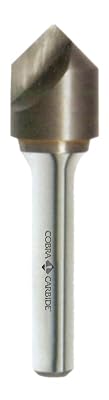
Cobra Carbide 1/8" 120-Degree Single Flute Countersink
This single solid carbide countersink features a 1/8-inch diameter and a 120-degree angle. The single flute design is typical for chip evacuation in certain materials. The 1-1/2 inch overall length and bright finish are standard for this type of tool. The 120-degree angle is distinct from the 60-degree center drills listed elsewhere, making it suitable for specific chamfering or countersinking applications where a wider angle is required.
It is a specialized tool for precise edge finishing.
- 1/8-inch diameter, 120-degree single flute carbide countersink
- 1-1/2 inch overall length with bright finish
Head-to-Head Comparisons
uxcell HSS vs BestParts Carbide: Material Choice
The BestParts set uses solid carbide, which is harder and allows for faster cutting speeds but is more brittle. If you are working in a CNC environment where speed and tool life are critical, the carbide bits from BestParts are the better fit. For manual drilling or less demanding applications where the tool might be dropped or misaligned, the HSS bits from uxcell offer greater durability against shock.
Both feature a 60-degree tip angle, so the choice comes down to the material's tolerance for heat and impact.
Shars #4 vs Shars #1: Size and Length
Both Shars sets are made from uncoated HSS and feature a plain type design, but they differ in trade size and overall length. The #4 set has a 2-1/8 inch overall length, providing more reach for deeper workpieces. The #1 set is shorter, at 1-1/4 inches, which is better suited for shallow holes or tight spaces.
The trade size determines the pilot diameter, so you must select the size that matches your required hole diameter. If you need a standard pilot hole for a larger drill, the #4 is a common choice. If you are working on small, shallow features, the #1 set is more appropriate.
Check your specific hole requirements before choosing between these two sizes.
Benchmark 90-Degree Burr vs Cobra 120-Degree Countersink
These two tools serve different functions despite both being carbide. The Benchmark burr has a 90-degree angle and is designed for sharp corners, deburring, and chamfering with a die grinder. It is a rotary cutting tool that removes material from edges. The Cobra Carbide countersink has a 120-degree angle and a single flute, designed specifically for countersinking or chamfering holes.
The 90-degree burr is more versatile for general edge finishing, while the 120-degree countersink is specialized for hole preparation. Choose the burr if you need to clean up sharp edges on flat surfaces, and the countersink if you need to prepare a hole for a specific fastener or chamfer.
Buying Guide
Material: HSS vs Carbide
High-speed steel (HSS) is a standard material for center drills, offering a good balance of cost and durability. It is more resistant to shock and impact than carbide. Solid carbide is harder and allows for higher cutting speeds, making it ideal for CNC machines and high-volume production.
However, carbide is brittle and can break if the tool is misaligned or impacted. For general shop use, HSS is often sufficient. For high-speed machining where tool life is a priority, carbide is the preferred choice.
Tip Angle: 60 vs 90 vs 120 Degrees
The tip angle determines the shape of the hole or chamfer created. A 60-degree angle is standard for center drills, creating a pilot hole for larger drills or taps. A 90-degree angle is common for burrs, used for chamfering sharp corners and edges. A 120-degree angle is often used for countersinks to prepare holes for specific fasteners or to create a wider chamfer.
Always match the tool angle to the requirement of your project. Using the wrong angle can result in a hole that does not fit the intended fastener or a chamfer that is too narrow or wide.
Shank Size and Compatibility
The shank size must match your drill chuck or tool holder. Most of the tools listed here feature a 1/4-inch shank, which is a common size for hand drills and small die grinders. Ensure that your equipment can accommodate the shank size of the tool you are purchasing.
Some tools may have different shank sizes, so always verify the specifications. Using a tool with a shank that is too large for your chuck can cause damage, while a shank that is too small may not provide a secure grip.
Set Quantity vs Single Tools
Some products are sold as sets, such as the uxcell 10-piece set or the Shars 5-piece sets. Sets are convenient if you need multiple identical tools for a project or for shop inventory. Single tools, like the Benchmark burr or Cobra countersink, are better if you only need one specific tool for a particular task.
Consider how many tools you will need and whether you want to buy a set for convenience or individual tools for specific applications. Sets often include a case for storage, which is a useful feature for keeping tools organized.
Frequently Asked Questions
What is the difference between a center drill and a countersink?
A center drill is used to create a pilot hole for larger drills or taps, typically with a 60-degree angle. A countersink is used to chamfer the edge of a hole, often with a 90 or 120-degree angle. Center drills are for hole preparation, while countersinks are for edge finishing.
Can I use HSS center drills in a CNC machine?
Yes, HSS center drills can be used in CNC machines, but solid carbide is often preferred for high-speed machining due to its greater hardness and wear resistance. HSS is more forgiving to impact, which can be an advantage in less controlled environments.
What does 'double end' mean in this context?
Double end means that the tool has cutting features on both ends. This allows you to use the tool in either direction or to have two different cutting profiles on a single tool. It increases the versatility of the tool and can extend its usable life.
How do I choose the right trade size for a Shars center drill?
The trade size corresponds to the pilot diameter of the drill. You should choose the trade size that matches the diameter of the pilot hole you need to create. Refer to the manufacturer's specifications for the exact diameter associated with each trade size, such as #1 or #4.
This article is part of our complete guide Tools & Home Improvement — browse all our comparisons and buying guides.
Last update on 2026-11-18 / Affiliate links / Images from Amazon Product Advertising API