
Selecting the right current sensor depends on whether you need to measure AC or DC, the current range, and how you plan to read the data. Some sensors provide analog outputs for simple microcontroller readings, while others use digital interfaces like I2C for more complex power monitoring.
This guide compares six electronic component current sensors, ranging from transformer-based AC detectors to Hall-effect and shunt-based DC monitors. We examine their sensing technologies, current ranges, and interfaces to help you match the sensor to your specific circuit monitoring needs.
Our 3 picks for different needs

Qoroos INA219 I2C DC Current Sensor
The Qoroos INA219 module offers I2C communication and power calculation, making it ideal for digital systems like battery management.
Read the details
Ferwooh ACS712 20A Hall Sensor
The Ferwooh ACS712 20A module supports higher current ranges, suitable for monitoring electric motors and switching power supplies.
Read the details
HiLetgo 5A AC Current Relay Module
The HiLetgo relay module includes a switch that can automatically trigger based on adjustable AC current thresholds.
Read the detailsAll products, in detail

HiLetgo ZMCT103C 5A AC Current Sensor
This three-pack module uses a micro-precision current transformer to measure alternating current up to 5A. It provides an active analog signal output with an onboard OP Amp, making it suitable for projects requiring AC detection without complex signal conditioning. The 5A/5mA analog output ratio simplifies integration with analog-to-digital converters.
It is a good choice for single-phase AC monitoring applications where a transformer-based isolation is preferred.
- Measures up to 5A of alternating current
- Features active analog signal output with OP Amp
Qoroos INA219 I2C DC Current Sensor
The Qoroos three-pack features the Texas Instruments INA219, a bidirectional current and power monitoring IC with an I2C interface. It operates at 3-5V and offers 12-bit resolution with a maximum error accuracy of ±1% across a -40°C to 85°C range. This module measures voltage drop across a shunt resistor while monitoring supply voltage to calculate power.
It is ideal for digital current sensing in battery management systems, servers, and telecommunications equipment.
- Supports bus voltage sensing from 0V to 26V
- Offers 12-bit resolution with ±1% accuracy
HiLetgo 5A AC Current Relay Module
This two-pack module combines a 5A AC current sensor with a relay switch for automated control. It supports 5V, 12V, or 24V operation and allows users to adjust the over-current signal setting critical point. The detection range spans AC 0.3A to 5A, with resolution adjustable via resistance parameters.
This is a practical option for projects requiring automatic switching or protection based on AC current levels, such as motor control or power monitoring systems.
- Includes AC current relay switch with 5V, 12V, or 24V options
- Adjustable over-current signal setting critical point

HiLetgo INA226 I2C Current Monitor
The HiLetgo two-pack features the INA226, a bidirectional current monitoring sensor with an I2C interface and alarm function. It is designed for high-accuracy applications in servers, telecom equipment, and power management systems. The module supports 16 programmable addresses, allowing multiple sensors to be connected to a single I2C bus.
It comes in a 10-pin DGS (VSSOP) package, making it suitable for compact digital monitoring setups.
- Supports 16 programmable I2C addresses
- Includes alarm function for current monitoring
Ferwooh ACS712 20A Hall Sensor
This three-pack module uses the ACS712ELC-20A chip to measure positive and negative currents up to 20A. It provides an analog output of 185mV/A and includes an integrated operating display for quick visual feedback. The module is powered by 5V and is based on Hall effect principles.
It is well-suited for detecting and managing current in electric motors and providing over-current error protection in switching power supplies.
- Measures ±20A with 185mV/A analog output
- Includes integrated operating display
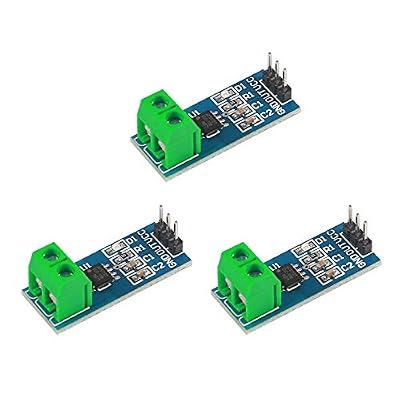
ACS712 5A Hall Sensor Module
This three-pack module features the ACS712ELC-05B chip, designed for measuring currents up to ±5A. It provides an analog output of 185mV/A and includes an on-board power indicator. The module is powered by 5V and uses Hall detection principles. It is a common choice for Arduino projects and other microcontroller-based systems requiring bidirectional current measurement in low-current applications.
- Measures ±5A with 185mV/A analog output
- Includes on-board power indicator
Head-to-Head Comparisons
HiLetgo ZMCT103C vs HiLetgo AC Relay: Signal vs Control
Both HiLetgo modules measure AC current up to 5A, but they serve different functions. The ZMCT103C provides an active analog signal output with an OP Amp, making it suitable for feeding data into a microcontroller for logging or display. The AC Relay module, however, includes a relay switch that can physically open or close a circuit based on the detected current.
If you need to monitor AC current and trigger an automatic response, such as cutting power during an over-current event, the relay module is the better fit. If you only need to read the current value for a display or data logger, the ZMCT103C is more appropriate.
Qoroos INA219 vs HiLetgo INA226: Resolution and Addressing
Both modules use I2C interfaces for digital current monitoring, but they differ in resolution and bus capabilities. The Qoroos INA219 offers 12-bit resolution and a maximum error accuracy of ±1%, making it suitable for general-purpose power monitoring in devices like laptops and servers. The HiLetgo INA226 supports 16 programmable addresses, which is advantageous when you need to connect multiple sensors to a single I2C bus without address conflicts.
If your project involves monitoring multiple power rails or batteries simultaneously, the INA226's address flexibility is a key advantage. For single-channel monitoring with a focus on cost-effectiveness and standard accuracy, the INA219 is a solid choice.
Ferwooh 20A vs ACS712 5A: Current Range Selection
Both modules use the ACS712 Hall-effect chip but are configured for different current ranges. The Ferwooh module uses the ACS712ELC-20A chip, measuring up to ±20A, while the other module uses the ACS712ELC-05B chip, measuring up to ±5A. The choice depends on the maximum current in your circuit.
If you are monitoring a high-power motor or a switching power supply that can draw up to 20A, the Ferwooh 20A module is necessary. If your application involves lower currents, such as a small DC motor or a logic circuit, the 5A module provides sufficient range.
Both provide an analog output of 185mV/A, so the signal conditioning requirements remain similar, but the physical current capacity of the chip differs.
Buying Guide
AC vs DC Sensing Technology
Determine whether you need to measure alternating current (AC) or direct current (DC). Transformer-based sensors, like the ZMCT103C, are designed specifically for AC and provide electrical isolation. Hall-effect sensors, like the ACS712 modules, can measure both AC and DC but rely on magnetic fields. Shunt-based sensors, like the INA219 and INA226, measure the voltage drop across a resistor and are typically used for DC.
Choosing the wrong technology for your current type will result in inaccurate or no readings.
Analog vs Digital Interface
Consider how you will read the sensor data. Analog sensors provide a voltage output proportional to the current, which is easy to read with a microcontroller's analog-to-digital converter (ADC). Digital sensors, such as those with I2C interfaces, provide processed data including current, voltage, and power calculations.
Digital interfaces are more complex to set up but offer higher precision and the ability to monitor multiple sensors on a single bus. If you are using a microcontroller with limited ADC channels, a digital I2C sensor may be more efficient.
Current Range and Resolution
Match the sensor's current range to your application. A sensor rated for 5A may not provide accurate readings if the current exceeds that limit, while a 20A sensor may have lower resolution for very small currents. Check the sensitivity specification, such as 185mV/A for the ACS712 modules, to ensure the output voltage falls within your microcontroller's input range.
For high-precision applications, consider sensors with specified accuracy ratings, such as the ±1% accuracy of the INA219.
Power Supply and Operating Voltage
Verify that the sensor's operating voltage matches your system. Most modules in this comparison operate at 5V, but some, like the INA219, support a range of 3-5V. Ensure that the power supply can provide sufficient current for the sensor and any onboard components, such as OP Amps or displays.
If you are powering the sensor from a battery, consider the quiescent current and whether the sensor supports low-power modes. Mismatched voltages can damage the sensor or lead to inaccurate readings.
Frequently Asked Questions
Can I use a DC current sensor to measure AC?
Hall-effect sensors like the ACS712 can measure both AC and DC because they detect the magnetic field generated by the current. However, transformer-based sensors are designed specifically for AC and will not work with DC. Shunt-based sensors are typically used for DC and may not provide accurate readings for AC without additional signal conditioning.
What is the difference between I2C and analog output?
Analog output provides a continuous voltage signal proportional to the current, which is read by an ADC. I2C is a digital communication protocol that allows the sensor to send processed data, such as current, voltage, and power, to a microcontroller. I2C sensors often offer higher precision and the ability to connect multiple sensors to a single bus.
Do I need a shunt resistor for these sensors?
Shunt-based sensors like the INA219 and INA226 require an external shunt resistor to measure the voltage drop across the current path. Hall-effect sensors like the ACS712 and transformer-based sensors like the ZMCT103C do not require an external shunt resistor, as they measure the magnetic field or induced voltage directly.
How do I choose the right current range?
Select a sensor with a current range that comfortably exceeds the maximum current in your circuit. For example, if your motor draws up to 10A, choose a sensor rated for at least 20A to ensure accuracy and avoid saturation. Using a sensor with a range too close to the maximum current can lead to reduced resolution and potential damage.
This article is part of our complete guide Electronics — browse all our comparisons and buying guides.
Last update on 2026-11-18 / Affiliate links / Images from Amazon Product Advertising API