
Selecting the right feeler gauge depends on the specific gap you need to measure and the environment in which you work. Whether you are adjusting valve clearance in an engine or setting up a guitar, the material and blade range of the tool are critical factors.
This comparison examines eight distinct feeler gauge options, ranging from single-piece foldable designs to two-piece sets with straight and angled heads. Each tool offers different measurement ranges and blade counts to suit various precision requirements.
Our pick: Mutt Tools Metric and Inch Feeler Gauge Set. The Mutt Tools set is explicitly listed as a feeler gauge guitar setup tool for musicians.
Our 3 picks for different needs

GEARWRENCH 32 Blade Deluxe SAE/Metric Feeler Gauge

The GEARWRENCH 161D includes a specific .010 brass blade designed for use with electronic ignitions.
Read the details
Mutt Tools Metric and Inch Feeler Gauge Set
The Mutt Tools set is explicitly listed as a feeler gauge guitar setup tool for musicians.
Read the details
Spurtar 32 Blades Tapered Feeler Gauge
The Spurtar tapered gauge folds into a plated steel case with a thumbscrew for safe carrying.
Read the detailsAll products, in detail
Mutt Tools Metric and Inch Feeler Gauge Set
This two-piece set includes straight and angled gauges for versatile access to tight spaces. It features blades ranging from 0.001 to 0.040 inch, including a specialized 2 mm thickness. The ergonomic handle design with secure blade retention helps keep the tool organized. This kit is suitable for valve clearance adjustments, engine work, and guitar setup where exact gap measurements are required.
- Includes straight and angled feeler gauges
- Blades range from 0.001 to 0.040 inch

Hoiny 2pcs Stainless Steel Feeler Gauge Set
Crafted from premium stainless steel, this set resists corrosion, wear, and rust. It includes a 32-blade straight gauge measuring 0.0008 to 0.04 inch and a 16-blade angled gauge covering 0.005 to 0.02 inch. Laser-etched markings in both metric and imperial units ensure readability. This configuration is ideal for precision areas such as automobile and motorcycle engines, spark plugs, and piston rings.
- Straight gauge measures 0.0008 to 0.04 inch
- Angled gauge covers 0.005 to 0.02 inch

Hotop 1pc Imperial Measuring Feeler Gauge
Made of 65 manganese steel, this single foldable gauge contains 32 blades. It measures from 0.0015 inch to 0.035 inch, with dual metric and imperial markings etched into the blades. The foldable design makes it easy to take and store. A warm notice indicates the presence of anti-rust oil on the stainless steel to prevent rusting.
- Contains 32 blades of 65 manganese steel
- Measures 0.0015 inch to 0.035 inch

Tokyzexi 2Pcs Straight & Angled Feeler Gauge Kit
This kit includes a 32-blade straight gauge and a 16-blade offset gauge made from hardened stainless steel. The straight gauge measures 0.04 to 0.88 mm, while the offset gauge covers 0.127 to 0.508 mm. A knurled knob on the pivot shaft allows for easy blade release and adjustment.
It is designed for measuring precise gap widths in engines, machines, and valves during maintenance.
- Straight gauge has 32 blades
- Offset gauge has 16 blades

Spurtar 32-Blade Stainless Steel Feeler Gauge
This portable tool set measures from 0.0015 inch to 0.035 inch using 32 blades of #65 manganese steel. It features a trigger pull gauge design for easy handling. The blades are coated with rust-preventive oil and polished for smooth operation. Marked with both metric and imperial readings, it is a practical tool for designers, engineers, and machinists.
- Measures 0.0015 inch to 0.035 inch
- Made of #65 manganese steel
GEARWRENCH 32 Blade Deluxe SAE/Metric Feeler Gauge
The GEARWRENCH 161D measures clearances from 0.0015 to 0.035 inch, with blades featuring both SAE and metric measurements. It includes one .010 brass blade specifically for use with electronic ignitions. The blade length is 3-5/16 inches and the width is 1/2 inch. This deluxe gauge is designed for professional automotive and industrial applications requiring precise gap settings.
- Includes one .010 brass blade
- Blade length is 3-5/16 inches
Spurtar 32 Blades Tapered Feeler Gauge
This tapered gauge set measures from 0.001 inch to 0.04 inch, with dual imperial and metric markings. It is made of high-quality flexible manganese steel that is hardened and polished. The set folds into a plated steel case with a thumbscrew for safe storage. The polished edges provide a smooth texture that does not hurt the hand during use.
- Measures 0.001 inch to 0.04 inch
- Folds into a plated steel case
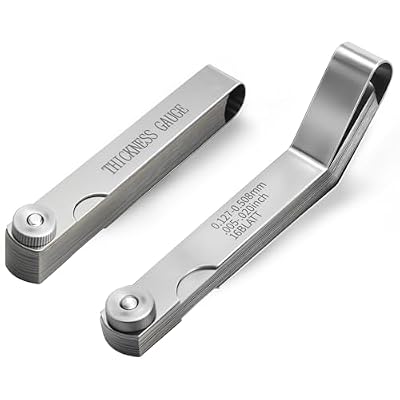
Maclia 2PCS Stainless Steel Straight & Angled Set
This set includes a 32-blade straight gauge and a 16-blade offset gauge made from hardened stainless steel. The straight gauge measures 0.04 to 0.88 mm, and the offset gauge covers 0.127 to 0.508 mm. The compact folding design with a smooth rotating joint allows for easy storage.
It is suitable for checking valve lash, spark plug gaps, and guitar fretwork.
- Straight gauge measures 0.04 to 0.88 mm
- Offset gauge covers 0.127 to 0.508 mm
Head-to-Head Comparisons
Hoiny vs Tokyzexi: Stainless Steel Two-Piece Sets
Both the Hoiny and Tokyzexi sets include a 32-blade straight gauge and a 16-blade angled gauge made from stainless steel. The Hoiny straight gauge measures from 0.0008 to 0.04 inch, while the Tokyzexi straight gauge measures from 0.04 to 0.88 mm. The Hoiny angled gauge covers 0.005 to 0.02 inch, whereas the Tokyzexi offset gauge covers 0.127 to 0.508 mm.
The Tokyzexi set features a knurled knob on the pivot shaft for blade release, while the Hoiny set emphasizes corrosion and wear resistance. Buyers should choose based on their preferred unit of measurement and the specific gap ranges they encounter most frequently.
Hotop vs Spurtar: Single-Piece Manganese Steel Gauges
The Hotop and Spurtar 32-blade gauges are both single-piece tools made from 65 manganese steel. The Hotop gauge measures from 0.0015 inch to 0.035 inch, while the Spurtar gauge measures from 0.0015 inch to 0.035 inch. Both feature dual metric and imperial markings etched into the blades.
The Hotop listing notes the presence of anti-rust oil, while the Spurtar listing mentions a rust-preventive coating and polished blades. The Spurtar gauge is described as a trigger pull gauge, which may offer a different handling experience compared to the standard foldable design of the Hotop.
Both are suitable for general workshop use where portability is a priority.
Spurtar Tapered vs GEARWRENCH Deluxe: Range and Specialization
The Spurtar tapered gauge measures from 0.001 inch to 0.04 inch, offering a wider range of thinner blades. The GEARWRENCH 161D measures from 0.0015 inch to 0.035 inch but includes a specific .010 brass blade for electronic ignitions. The Spurtar gauge folds into a plated steel case, while the GEARWRENCH gauge has a blade length of 3-5/16 inches.
The GEARWRENCH tool is designed for professional automotive use with its specialized brass blade, whereas the Spurtar tool is a general-purpose tapered gauge. Buyers working on electronic ignition systems may find the GEARWRENCH more suitable, while those needing a wider range of thin blades may prefer the Spurtar.
Buying Guide
Measurement Range and Blade Count
The range of a feeler gauge determines the gaps it can measure. Some gauges start at 0.0008 inch, while others start at 0.0015 inch. The upper limit also varies, with some reaching 0.035 inch and others 0.040 inch. A higher blade count, such as 32 blades, provides more granular options for precise adjustments.
Consider the specific gaps you need to measure regularly to ensure the gauge covers your required range.
Material and Durability
Feeler gauges are typically made from stainless steel or manganese steel. Stainless steel offers excellent rust resistance and durability in oily or humid environments. Manganese steel is also durable and often features a rust-preventive coating. The material affects how the gauge holds up over time and in different workshop conditions.
Check the material specification to ensure it matches your maintenance environment.
Straight vs Angled Heads
Straight gauges are ideal for general gap measurements, while angled or offset gauges provide access to tight and hard-to-reach spots. Two-piece sets often include both types, offering versatility for different applications. The angled head can reach into confined spaces that a straight blade cannot. If you work on engines or complex machinery, a set with both straight and angled gauges may be more useful.
Storage and Portability
Foldable gauges are easy to store and carry, often folding into a compact case or holder. Some gauges feature a thumbscrew or knurled knob for secure blade retention. A protective holder prevents blade damage and keeps the tool organized. If you move between work sites, a portable design with a secure case is beneficial.
Check the storage mechanism to ensure it suits your workflow.
Frequently Asked Questions
What is the difference between SAE and metric feeler gauges?
SAE gauges use imperial units like inches, while metric gauges use millimeters. Many modern gauges are dual-marked with both SAE and metric measurements on each blade. This allows users to read the gauge in their preferred unit without needing to convert. Check the listing to see if the gauge is dual-marked.
Can I use a feeler gauge for guitar setup?
Yes, feeler gauges are commonly used for guitar setup to measure the gap between the strings and the frets. Some gauges are specifically marketed for this use. The precision of the gauge ensures accurate string height adjustments. A gauge with a wide range of thin blades is ideal for this application.
How should I store a feeler gauge to prevent rust?
Many feeler gauges come with a rust-preventive oil coating. To maintain this protection, wipe the blades clean and apply a light coat of oil before storage. Storing the gauge in a dry environment also helps prevent rust. Follow the manufacturer's storage recommendations for best results.
What is a brass blade used for in a feeler gauge?
A brass blade is often included in deluxe gauges for use with electronic ignitions. Brass is non-ferrous and does not interfere with magnetic fields, making it suitable for certain ignition systems. The GEARWRENCH 161D includes a .010 brass blade for this specific purpose. Check the listing to see if a brass blade is included.
This article is part of our complete guide Industrial & Scientific — browse all our comparisons and buying guides.
Last update on 2026-11-18 / Affiliate links / Images from Amazon Product Advertising API