
Industrial ceiling fans are engineered to move large volumes of air efficiently, making them suitable for expansive spaces such as warehouses, gyms, garages, and large residential rooms. Unlike standard residential fans, these units often feature larger diameters, ranging from 56 inches to 120 inches, and utilize high-efficiency DC motors to reduce energy consumption while maintaining powerful airflow. The selection includes models with varying blade counts, materials, and control mechanisms, allowing users to match the fan to their specific spatial and aesthetic requirements. Key considerations include the type of motor, blade material, control interface, and installation compatibility. Some models offer integrated lighting, while others focus solely on air circulation. Warranty terms also vary significantly, with some manufacturers providing extended coverage for the motor. This guide explores the essential features and specifications of available industrial ceiling fans to help you make an informed decision based on your space size, noise tolerance, and functional needs.
All products, in detail




Buying Guide
Motor Type and Energy Efficiency
The type of motor significantly impacts performance and energy usage. Many models in this category utilize DC motors, which are noted for being more energy-efficient than traditional AC motors. For instance, one 120-inch model claims to consume 70% less power than AC fans, while another states it saves up to 75% energy. DC motors are also associated with quieter operation, with noise levels reported as low as 30dB to 40dB, comparable to a library or soft footsteps. In contrast, some Westinghouse models feature high-quality motors that deliver powerful air movement and quiet performance but do not specify DC technology in their provided features. When selecting a fan, consider the energy savings and noise reduction benefits of DC motors, especially for spaces where the fan will run continuously.
Blade Size, Material, and Airflow
Blade diameter determines the coverage area, with options ranging from 56 inches to 120 inches. Smaller 56-inch fans are suitable for rooms up to 400 square feet, while 120-inch HVLS (High Volume Low Speed) fans can cover areas up to 2,500 square feet or more. Blade material is crucial for durability; aluminum blades are common, described as robust, unbendable, and rust-resistant. Some models feature reversible blades with different finishes on each side, such as black and wood grain or black and walnut, allowing for aesthetic changes. Airflow capacity varies, with larger fans moving significant volumes of air, such as 11,500 CFM for a 100-inch model and up to 36,000 CFM for certain 120-inch units. Ensure the fan size matches your room dimensions to avoid inefficiency.
Control Options and Features
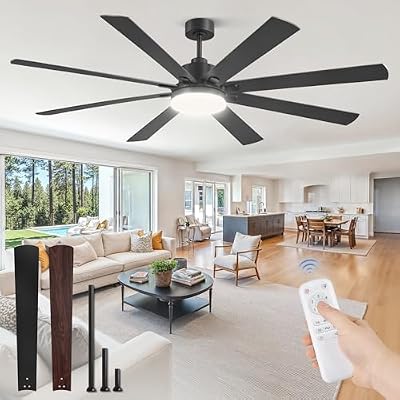
Convenience is enhanced through various control mechanisms. Remote controls are prevalent, offering features like 6-speed settings, timer functions, and motor reverse modes. Some remotes include memory functions that recall the last speed setting. Wall controls are also available, providing easy on/off and speed adjustments without the need for a handheld device. Reversible motors allow for year-round use; clockwise rotation creates a downward breeze for cooling in summer, while counterclockwise rotation circulates warm air in winter. Additional features may include integrated LED lighting with adjustable color temperatures (3000K/4500K/6000K) and brightness levels, though some models are fan-only. Check if the control method suits your installation height and accessibility needs.
Installation and Warranty
Installation requirements vary by model. Most fans include downrods of different lengths (e.g., 6, 12, 24 inches) to accommodate various ceiling heights. Some models support sloped ceilings up to 15 degrees. J-hook installation systems are mentioned for certain Westinghouse models. Ease of installation is highlighted by some brands, with claims of DIY setup in under 30 minutes using included hardware and manuals. Warranty coverage is a key differentiator; some models offer a 15-year limited motor warranty, while others provide 3-year, 5-year, or 10-year warranties for the motor and parts. Always verify the specific warranty terms and certification standards (such as UL, CE, ETL) to ensure safety and long-term support.
Frequently Asked Questions
What is the difference between DC and AC motors in industrial ceiling fans?
DC motors are generally more energy-efficient, consuming up to 70-75% less power than AC motors according to some product claims. They also tend to operate more quietly, with noise levels as low as 30-40dB. AC motors are traditional and may be found in some models, but DC motors are increasingly common for their efficiency and quiet performance.
How do I choose the right fan size for my space?
Fan size should correspond to the square footage of the room. 56-inch fans are suitable for rooms up to 400 square feet. Larger spaces, such as warehouses or gyms, may require 72-inch, 100-inch, or 120-inch fans. A 120-inch fan can cover areas up to 2,500 square feet. Consider the ceiling height and the desired airflow coverage when selecting the diameter.
Can industrial ceiling fans be used outdoors?
Some models are rated for indoor/outdoor use, particularly those with damp-rated construction. Features such as rust-resistant aluminum blades and specific certifications may indicate suitability for covered patios, barns, or garages. However, not all industrial fans are weather-resistant, so check the product specifications for outdoor ratings before installation in exposed areas.
Do these fans come with lighting?
Lighting options vary by model. Some industrial ceiling fans are fan-only units without lights. Others include integrated LED panels with adjustable brightness and color temperatures. If lighting is required, look for models that specify LED panel dimensions, lumens, and color temperature options. Fan-only models are often preferred for spaces where lighting is provided by other sources.
What warranty coverage is typically available?
Warranty terms vary significantly by brand and model. Some manufacturers offer a 15-year limited motor warranty, while others provide 3-year, 5-year, or 10-year warranties for the motor and parts. Additional coverage may include lifetime tech support or 24-hour customer service. Always review the specific warranty details provided with the product to understand the duration and scope of coverage.
This article is part of our complete guide Industrial & Scientific — browse all our comparisons and buying guides.