
Selecting the right industrial compound gauge requires balancing accuracy, environmental durability, and connection compatibility. Whether you are monitoring HVAC systems, hydraulic presses, or general machinery, the specific features of the gauge must align with your operational needs.
This comparison examines eight distinct gauges, ranging from liquid-filled models for vibration dampening to dry gauges for clear visibility. We focus on documented specifications such as accuracy grades, filling types, and connection styles to help you make an informed decision for your specific application.
Our 3 picks for different needs

MEASUREMAN 2.5 Inch HVAC Compound Gauge
The silicone oil filling ensures accurate readings in temperatures ranging from -40°F to 140°F, making it suitable for extreme weather conditions.
Read the details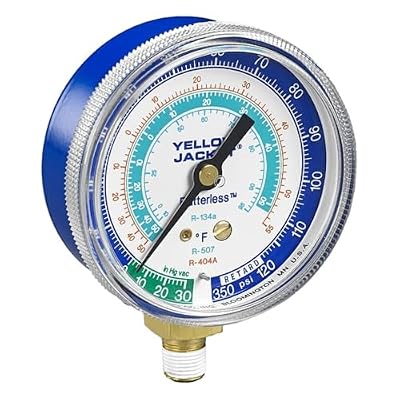
Yellow Jacket 49052 120 PSI Blue Compound Gauge
Designed for R-134A, 404A, and 507 refrigerants with a 1/8 NPT male connection, this gauge is tailored for specific HVAC refrigerant systems.
Read the details
CARBO Instruments 30 PSI Back Mount Gauge
The 1/4 NPT back mount connection and compatibility with panel mounting brackets make this gauge ideal for rear-entry equipment layouts.
Read the detailsAll products, in detail

CARBO Instruments -30 inHg to 60 PSI Gauge
This CARBO Instruments gauge features a 2.5-inch dial with a 304 stainless steel case and brass wetted parts. It is liquid-filled with glycerin to dampen vibration and provide stable readings. The gauge offers ASME B40.1 Grade A accuracy and a 1/4 NPT lower mount connection.
It is suitable for air, oil, water, and gas systems in industrial and commercial settings. Buyers needing a mid-range pressure capacity with high-contrast markings will find this model a reliable choice for general machinery monitoring.
- ASME B40.1 Grade A accuracy with +/-2-1-2% tolerance
- Glycerin-filled for stable pointer movement and vibration dampening

CARBO Instruments -30 inHg to 100 PSI Gauge
The CARBO Instruments 100 PSI model shares the same 2.5-inch dial and 304 stainless steel construction as its 60 PSI counterpart. It includes glycerin filling to stabilize readings against pulsation and needle flutter. The gauge meets ASME B40.1 Grade A accuracy standards and features a standard 1/4 NPT lower connection.
This variant is ideal for applications requiring higher pressure monitoring, such as compressors and hydraulic presses, while maintaining the same robust, rust-resistant case design.
- Pressure range extends to 100 PSI for higher capacity systems
- Chrome-plated brass connection and polycarbonate lens for impact resistance
MEASUREMAN 2.5 Inch HVAC Compound Gauge
The MEASUREMAN gauge is designed for all-weather use with silicone oil filling that remains accurate from -40°F to 140°F. It features a rugged 304 stainless steel case and a 1/4 NPT lower mount. The silicone filling prevents freezing and heat degradation, making it suitable for extreme temperature environments.
This gauge is a strong option for HVAC technicians who need reliable readings in both cold and hot conditions, offering a universal fitment for direct replacement on most equipment.
- Silicone oil filling supports operation from -40°F to 140°F
- Vibration-proof design absorbs shock from running pumps and compressors

CARBO Instruments 30 PSI Dry Compound Gauge
This CARBO Instruments gauge is a dry, chrome-plated steel case model with a 2.5-inch dial. It features a glass window lens and brass and copper alloy wetted parts. The gauge complies with ASME B40.1 Grade B accuracy standards and offers a dual scale in psi and bar.
It is designed for media that are not highly viscous or corrosive to copper alloys. This option is suitable for buyers who prefer a dry gauge with a traditional glass lens for clear visibility in standard industrial applications.
- ASME B40.1 Grade B accuracy with +/-3-2-3% tolerance
- Dry construction with a glass window lens and chrome-plated steel case
Yellow Jacket 49052 120 PSI Blue Compound Gauge
The Yellow Jacket 49052 is a 2.5-inch blue compound gauge designed for R-134A, 404A, and 507 refrigerants. It features a 1/8 NPT male connection and offers 3-2-3% accuracy with calibration traceable to NIST standards. The gauge is specifically tailored for HVAC and refrigeration applications where refrigerant compatibility is a primary concern.
Its blue dial and specific connection size make it a specialized tool for technicians working with modern refrigerant systems.
- Compatible with R-134A, 404A, and 507 refrigerants
- Features a 1/8 NPT male connection for specific refrigerant fittings

Yellow Jacket 40332 Blue Compound Gauge with Coupler
This Yellow Jacket gauge includes a 19110 quick coupler, making it ready for immediate use in recovery tank pressure checks. It features a blue compound dial and is designed for specific refrigerant applications. The inclusion of the quick coupler simplifies the connection process for technicians who need to perform rapid checks without additional adapters.
This model is a convenient option for field service professionals who prioritize ease of connection and quick deployment.
- Includes a 19110 quick coupler for immediate connection
- Designed for recovery tank pressure checks with a blue compound dial
CARBO Instruments 30 PSI Back Mount Gauge
The CARBO Instruments 30 PSI gauge features a 1/4 NPT back mount connection, ideal for panel and rear-entry installations. It is liquid-filled with glycerin and housed in a 304 stainless steel case with brass wetted parts. The gauge meets ASME B40.1 Grade A accuracy standards and is designed to accept a compatible panel mounting bracket.
This model is a good fit for equipment layouts where a rear connection is preferred, offering the same high-contrast dial and vibration dampening as other CARBO liquid-filled models.
- 1/4 NPT back mount connection for rear-entry installations
- Compatible with panel mounting brackets for secure installation

CARBO Instruments 15 PSI Dry Compound Gauge
This CARBO Instruments gauge is a dry, chrome-plated steel case model with a 2.5-inch dial and a 15 PSI pressure range. It features a glass window lens and brass and copper alloy wetted parts. The gauge complies with ASME B40.1 Grade B accuracy standards and offers a dual scale in psi and bar.
It is suitable for low-pressure applications where a dry gauge with a traditional glass lens is preferred. This option is ideal for monitoring systems that do not require the vibration dampening of a liquid-filled gauge.
- Pressure range of 15 PSI for low-pressure monitoring
- Dry construction with a glass window lens and chrome-plated steel case
Head-to-Head Comparisons
CARBO 60 PSI vs 100 PSI: Pressure Range Selection
Both CARBO Instruments gauges share the same 2.5-inch dial, 304 stainless steel case, and glycerin filling. The primary difference is the maximum pressure capacity, with the 60 PSI model suitable for lower-pressure systems and the 100 PSI model for higher-capacity applications. If your system operates near the 60 PSI limit, the 100 PSI model provides a wider safety margin.
Buyers should verify their system's maximum operating pressure to ensure the gauge's range is appropriate for accurate and safe monitoring.
MEASUREMAN Silicone vs CARBO Glycerin: Filling Type
The MEASUREMAN gauge uses silicone oil filling, which is rated for extreme temperatures from -40°F to 140°F. If your application involves significant temperature fluctuations, the MEASUREMAN silicone-filled gauge offers broader environmental tolerance. For standard industrial environments where temperature is stable, the CARBO glycerin-filled gauge provides reliable vibration dampening and stable readings.
CARBO 30 PSI vs 15 PSI: Dry Gauge Pressure Ranges
Both CARBO dry gauges feature chrome-plated steel cases, glass window lenses, and ASME B40.1 Grade B accuracy. The 30 PSI model offers a wider pressure range, making it suitable for a broader variety of low to medium-pressure applications. The 15 PSI model is more specialized for very low-pressure systems where finer resolution within a smaller range is beneficial.
Buyers should select the gauge whose pressure range closely matches their system's operating parameters to ensure optimal reading precision.
Buying Guide
Understanding Accuracy Grades
ASME B40.1 defines accuracy grades for pressure gauges. Grade A offers tighter tolerances, typically +/-2-1-2% of span, while Grade B offers +/-3-2-3% of span. For critical industrial applications where precise pressure monitoring is essential, Grade A gauges provide higher reliability. For general monitoring where slight variations are acceptable, Grade B gauges may be sufficient.
Always verify the accuracy grade listed in the product specifications to ensure it meets your operational requirements.
Choosing the Right Filling Type
Liquid-filled gauges use glycerin or silicone oil to dampen vibration and stabilize pointer movement. Glycerin is common for general industrial use, while silicone oil offers better performance in extreme temperatures. Dry gauges do not have liquid filling and feature a glass lens, which can be easier to clean but may be more susceptible to needle flutter in high-vibration environments.
Consider the environmental conditions and vibration levels of your application when selecting between liquid-filled and dry gauges.
Connection Style and Compatibility
Gauges come with different connection styles, including lower mount and back mount. Lower mount connections are standard for most equipment, while back mount connections are ideal for panel installations. The thread size, typically 1/4 NPT or 1/8 NPT, must match your equipment's fittings. Verify the connection type and thread size before ordering to ensure compatibility.
Some gauges, like the Yellow Jacket models, include specific couplers for quick connection to refrigerant systems.
Material and Environmental Durability
The case material and wetted parts determine the gauge's durability and compatibility with different media. 304 stainless steel cases provide rust resistance and impact protection, while chrome-plated steel cases offer a durable, traditional finish. Wetted parts made of brass and copper alloys are suitable for non-corrosive media.
For applications involving corrosive fluids or extreme temperatures, ensure the gauge's materials are compatible with the specific media and environmental conditions to prevent damage and ensure long-term reliability.
Frequently Asked Questions
What is the difference between Grade A and Grade B accuracy?
Grade A accuracy offers tighter tolerances, typically +/-2-1-2% of span, making it suitable for critical applications. Grade B accuracy offers +/-3-2-3% of span, which is sufficient for general monitoring. Choose Grade A for higher precision and Grade B for standard industrial use.
Can I use a glycerin-filled gauge in extreme cold?
Glycerin-filled gauges may not perform optimally in extreme cold, as the liquid can thicken or freeze. Silicone oil-filled gauges are rated for lower temperatures, such as -40°F, making them a better choice for extreme cold environments. Check the specific temperature rating of the gauge's filling type.
What does a 1/4 NPT connection mean?
1/4 NPT refers to a National Pipe Thread size, which is a standard thread type for pressure gauge connections. It ensures compatibility with most regulators, tanks, and manifolds. Verify that your equipment's fitting matches the gauge's connection size and thread type to ensure a secure and leak-free installation.
Are these gauges suitable for oxygen service?
For oxygen applications, you must use gauges specifically designed and certified for oxygen service to ensure safety and prevent potential hazards.
This article is part of our complete guide Industrial & Scientific — browse all our comparisons and buying guides.
Last update on 2026-11-20 / Affiliate links / Images from Amazon Product Advertising API