
Selecting the right industrial T strainer depends on your pipe diameter, required filtration density, and system pressure. These eight options range from 1/2-inch PVC fittings to 1-1/2-inch high-pressure industrial units.
Each product offers distinct materials and mesh configurations, from 304 stainless steel to 316 stainless steel screens. Review the specific micron ratings and pressure limits to ensure compatibility with your plumbing or fluid system.
Our 3 picks for different needs

Banjo 3/4" 50 Mesh T-Line Strainer
The Banjo 3/4-inch model is rated for 150 degrees F fluid temperature and 150 PSI, making it suitable for heated fluid systems.
Read the details
YELUN 3/4" Brass T Strainer with Cap
The YELUN brass strainer includes GHT adapters and dual mesh screens, fitting standard garden hose and pressure washer connections.
Read the details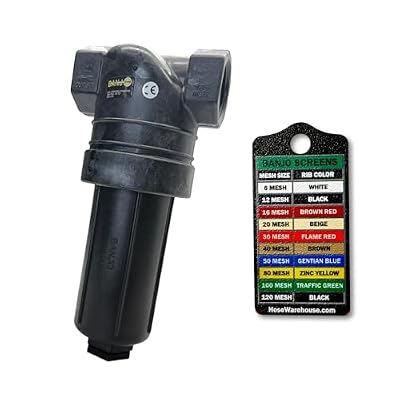
Banjo 1-1/2" 50 Mesh T-Line Strainer
The Banjo 1-1/2-inch strainer offers a 300 PSI rating and larger diameter, fitting high-pressure industrial fluid handling needs.
Read the detailsAll products, in detail

SAFBY 3/4" 100 Mesh In-Line Strainer
This 3/4-inch female NPT in-line strainer features a 100 mesh stainless steel screen for fine filtration. It includes a clear nylon bowl that allows users to visually inspect the screen for debris. The twist-off design simplifies cleaning and maintenance. This unit is suitable for applications requiring high mesh density in a standard 3/4-inch pipe connection.
- 100 mesh stainless steel filter screen
- Clear nylon bowl for visual inspection

1 Inch 40 Mesh In-Line Strainer
Designed for 1-inch female NPT connections, this in-line strainer uses a 40 mesh stainless steel screen. It shares the same physical dimensions and clear nylon bowl construction as the 3/4-inch variant, allowing for easy visual monitoring of clogging. The twist-off bowl facilitates quick disassembly for cleaning.
This option is appropriate for larger pipe sizes where coarser filtration is sufficient.
- 1 inch female NPT connection
- 40 mesh stainless steel screen

3/4" 297 Micron T-Line Strainer
This T-line strainer is specified for 3/4-inch pipes with a 297 micron filtration rating. The listing provides minimal feature details beyond the size and micron rating. It is a standard T-line configuration suitable for general debris removal in 3/4-inch lines. Buyers should verify specific material and pressure ratings against their system requirements before purchase.
- 3/4 inch pipe size
- 297 micron filtration rating
Banjo 3/4" 50 Mesh T-Line Strainer
The Banjo LST075-50 is a heavy-duty T-line strainer with a polypropylene housing and glass-reinforced construction. It features a 50 mesh 316 stainless steel screen and a black bowl. Rated for 150 PSI at 70 degrees F and 150 degrees F fluid temperature, it includes an EPDM gasket and a clean-out plug.
This model is designed for robust industrial or agricultural fluid handling.
- 316 stainless steel 50 mesh screen
- 150 PSI max pressure rating

Cotonlake 1/2" PVC T Strainer
This 1/2-inch T strainer connects to PVC DN15 water pipes via a 2cm inner diameter joint. It features a 304 stainless steel filter head and is designed for use in swimming pools, fish tanks, and water pumps. The unit allows for 3-angle installation and direct insertion into 1/2-inch diameter pipes.
It is a compact option for smaller diameter plumbing and filtration needs.
- 1/2 inch PVC DN15 connection
- 304 stainless steel filter head
YELUN 3/4" Brass T Strainer with Cap
This brass T-line strainer includes both 100 mesh and 40 mesh 304 stainless steel screens, allowing users to select filtration density. It connects via 3/4-inch GHT or NPT male threads and includes two GHT to NPT adapters. The kit also contains a hose end cap, PTFE tape, and a rubber gasket.
It is suitable for garden hoses, pressure washers, and RV applications.
- Includes 100 and 40 mesh screens
- Heavy brass body construction
Banjo 1-1/2" 50 Mesh T-Line Strainer
The Banjo LST150-50 is a 1-1/2-inch T-line strainer with a durable polypropylene housing. It features a 50 mesh stainless steel screen and is rated for 300 PSI maximum pressure. The unit includes a bonus keychain that identifies mesh filter sizes. This larger diameter model is ideal for high-pressure industrial, agricultural, and fluid handling systems requiring medium particle filtration.
- 1-1/2 inch female NPT connections
- 300 PSI max pressure rating

YELUN 3/4" Brass T Strainer with Valve
Similar to the cap version, this YELUN brass strainer includes 100 and 40 mesh screens and GHT to NPT adapters. It differs by including a 45-degree elbow with a shut-off valve instead of a hose end cap. This configuration allows for flow control and drainage without full disassembly.
It is well-suited for pressure washer inlets and camping setups where a valve is preferred.
- Includes 45-degree elbow with shut-off valve
- Heavy brass body with dual screens
Head-to-Head Comparisons
SAFBY 3/4" vs 1 Inch In-Line Strainers
Both the SAFBY 3/4-inch and the 1-inch in-line strainers feature clear nylon bowls and twist-off designs for easy cleaning. The primary difference is the pipe size and mesh density. The 3/4-inch model uses a 100 mesh screen for finer filtration, while the 1-inch model uses a 40 mesh screen.
Choose the 3/4-inch option if you need to capture smaller particles in a standard residential line. Select the 1-inch model if you are working with larger diameter pipes where coarser filtration is acceptable.
Banjo 3/4" vs 1-1/2" T-Line Strainers
These two Banjo T-line strainers share a 50 mesh stainless steel screen and polypropylene housing but differ significantly in size and pressure rating. The 3/4-inch model is rated for 150 PSI and 150 degrees F, while the 1-1/2-inch model is rated for 300 PSI. The larger 1-1/2-inch unit is better suited for high-pressure industrial systems.
The 3/4-inch model is more appropriate for standard agricultural or lower-pressure fluid handling applications.
YELUN Cap vs Valve T Strainers
Both YELUN brass strainers include 100 and 40 mesh screens and GHT to NPT adapters. The key distinction is the included accessory: the cap version comes with a hose end cap, while the valve version includes a 45-degree elbow with a shut-off valve. If you need to isolate the strainer for maintenance or drainage, the valve version is the better fit.
If you simply need a standard connection for a hose or pipe, the cap version is sufficient.
Buying Guide
Match Pipe Diameter and Connection Type
Verify the thread type and diameter of your existing plumbing. Options range from 1/2-inch PVC to 1-1/2-inch female NPT. Ensure the strainer's connection type, such as GHT or NPT, matches your system. Mismatched connections will require adapters, which may not be included in all kits.
Select Appropriate Mesh Density
Mesh density determines the size of particles filtered. Lower numbers, like 40 mesh, allow larger particles to pass, while higher numbers, like 100 mesh, capture finer debris. Choose a mesh size that balances filtration efficiency with flow rate. Clogging a high-flow system with too fine a mesh can reduce performance.
Check Pressure and Temperature Ratings
Industrial applications often involve high pressure or temperature. Check the maximum PSI and fluid temperature ratings for each strainer. For example, some polypropylene models are rated for 150 PSI, while others handle 300 PSI. Ensure the rating exceeds your system's maximum operating conditions to prevent failure.
Consider Material Compatibility
Strainer housings and screens are made from various materials, including nylon, polypropylene, brass, and stainless steel. Ensure the material is compatible with the fluid being filtered. Stainless steel screens offer corrosion resistance, while brass bodies provide durability for water applications. Check for specific chemical compatibility if filtering non-water fluids.
Frequently Asked Questions
What is the difference between a T strainer and an in-line strainer?
A T strainer has a three-way configuration with a removable bowl for cleaning, while an in-line strainer is a straight-through device. T strainers are generally easier to clean and inspect, making them popular for industrial and maintenance-heavy applications.
Can I use a 3/4-inch strainer in a 1-inch pipe?
No, you cannot directly connect a 3/4-inch strainer to a 1-inch pipe without a reducer. You would need a 1-inch to 3/4-inch reducer fitting. It is better to select a strainer that matches your pipe diameter to avoid flow restriction and installation complexity.
How often should I clean a T strainer?
Cleaning frequency depends on the debris load in your fluid system. Strainers with clear bowls allow you to visually inspect the screen. Clean the strainer whenever the screen appears clogged or when flow rate decreases. Regular inspection prevents pressure buildup and system strain.
Are these strainers suitable for potable water?
Some models, like those with 304 or 316 stainless steel screens, are suitable for potable water. However, always verify that the housing material and gaskets are rated for potable water use. Check the specific product details for material safety certifications if you are filtering drinking water.
This article is part of our complete guide Home & Kitchen — browse all our comparisons and buying guides.
Last update on 2026-11-25 / Affiliate links / Images from Amazon Product Advertising API