
Selecting the correct lip seal requires matching the inner diameter, outer diameter, and width to your specific shaft and housing dimensions. The material composition, such as nitrile rubber or fluorine rubber, determines the temperature range and chemical resistance of the seal.
This comparison covers eight options ranging from heavy-duty trailer axle grease seals to compact industrial shaft seals. Each product is listed with its specific dimensions and material properties to help you identify the right fit for your machinery.
Our pick: Fugedox 22333TB Double Lip Grease Seal. The Fugedox 22333TB seals are sized for 5,200 to 7,000 lb axles with D42 spindles, making them a direct fit for common heavy trailer configurations.
Our 3 picks for different needs
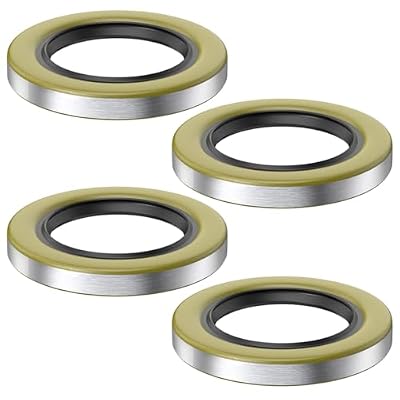
Fugedox 22333TB Double Lip Grease Seal
The Fugedox 22333TB seals are sized for 5,200 to 7,000 lb axles with D42 spindles, making them a direct fit for common heavy trailer configurations.
Read the details
uxcell 25mm Fluorine Rubber Oil Seal
The uxcell 25mm fluorine rubber seal supports temperatures up to 392 degrees F, which is significantly higher than standard nitrile options.
Read the details
Yethuanru 12mm Double Lip Oil Seal
The Yethuanru 12mm seals are small enough for tight spaces in gearboxes and hydraulic pumps, and the package includes grease for installation.
Read the detailsAll products, in detail
Fugedox 22333TB Double Lip Grease Seal
This four-pack of double lip grease seals is designed specifically for 5,200 to 7,000 lb trailer axles with D42 spindles. The 2.250 inch inner diameter and 3.371 inch outer diameter dimensions align with common Dexter 10-36 replacements. It is suitable for EZ-Lube axles and works with 12 inch hubs and specific bearing sets.
Buyers maintaining heavy-duty trailers should verify their spindle type before ordering.
- Fits 5,200 lb to 7,000 lb EZ-Lube Axles and D42 Spindles
- Includes four seals with 2.250 inch ID and 3.371 inch OD
uxcell 25mm Fluorine Rubber Oil Seal
Constructed from fluorine rubber, this two-pack of TC shaft oil seals offers a wide operating temperature range from -13 degrees F to 392 degrees F. The 25mm inner diameter and 52mm outer diameter make it suitable for high-heat industrial applications. The self-tightening coil spring and 70A durometer body help prevent oil leakage and dust ingress.
It is a strong choice for machinery operating in extreme thermal conditions.
- Fluorine rubber body with 70A durometer
- Temperature range from -13 degrees F to 392 degrees F

uxcell 35mm Nitrile Rubber Oil Seal
This single-pack TC oil seal features a 35mm inner diameter and 72mm outer diameter, constructed from standard 70A nitrile rubber. It includes a double lip design with a spring and rubber cover to improve sealing ability. The material offers good resistance to petroleum oils, greases, and hydraulic fluids.
It is appropriate for standard temperature industrial equipment where nitrile rubber is the required material specification.
- 35mm ID, 72mm OD, and 10mm width
- Nitrile rubber with temperature range from -4 degrees F to 212 degrees F
Yethuanru 12mm Double Lip Oil Seal
This two-pack of black TC type oil seals measures 12mm in inner diameter and 22mm in outer diameter. Made from premium nitrile rubber, they feature a double lip with a clamping spring and rubber cover. The package includes a small packet of grease for installation.
These small-diameter seals are suitable for gearboxes, hydraulic pumps, and transmissions where compact size is required.
- 12mm ID, 22mm OD, and 5mm thickness
- Includes two seals and a packet of grease

uxcell 25mm Nitrile Rubber Oil Seal
This TC double lip oil seal has a 25mm inner diameter and 40mm outer diameter, made from standard 70A nitrile rubber. It is designed to protect shafts and bearings from dirt ingress and oil egress. The material provides good resistance to various petroleum-based fluids. It is a standard replacement part for machinery operating within the -4 degrees F to 212 degrees F temperature range.
- 25mm ID, 40mm OD, and 7mm width
- Standard 70A NBR material

NOOTO 10-36-LOTOF4 Double Lip Grease Seal
This four-pack of double lip grease seals is sized at 2.25 inch ID and 3.376 inch OD, designed for 5200, 6000, and 7000 lb trailer or boat axles. It is compatible with both EZ Lube and Non EZ Lube axles from brands like Dexter and ALKO AXIS.
The double lip design helps retain grease and keep contaminants out. It serves as a cross-reference for several common trailer axle part numbers.
- 2.25 inch ID and 3.376 inch OD
- Compatible with EZ Lube and Non EZ Lube trailer axles

PATIKIL 14mm Nitrile Rubber Oil Seal
This five-pack of oil seals measures 14mm in inner diameter and 22mm in outer diameter, made from USH nitrile rubber with 80 Shore hardness. The temperature range extends from -20 degrees C to 120 degrees C. The scientific design facilitates convenient installation in machinery, cylinders, and electrical appliances.
It is suitable for applications requiring reliable sealing under varying pressures and temperatures.
- 14mm ID, 22mm OD, and 5mm thickness
- USH nitrile rubber with 80 Shore hardness

uxcell 40mm Polyurethane Oil Seal
This single TC rotary shaft oil seal features a 40mm inner diameter and 52mm outer diameter. It is constructed from polyurethane and rubber with a metal spring. The 7mm width and black color are standard for this model. It is a lightweight option weighing 12g, suitable for general industrial shaft sealing where polyurethane material properties are preferred.
- 40mm ID, 52mm OD, and 7mm width
- Constructed from Polyurethane, Rubber, and Metal Spring
Head-to-Head Comparisons
Fugedox vs NOOTO: Trailer Axle Grease Seals
Both the Fugedox and NOOTO products are double lip grease seals designed for trailer axles, but they differ slightly in outer diameter. The Fugedox 22333TB has a 3.371 inch outer diameter, while the NOOTO 10-36-LOTOF4 has a 3.376 inch outer diameter. Both share a 2.25 inch inner diameter.
The NOOTO listing explicitly mentions compatibility with both EZ Lube and Non EZ Lube axles, whereas the Fugedox listing specifies EZ-Lube axles. Buyers should measure their existing seals to determine which outer diameter matches their housing.
uxcell Fluorine vs Nitrile: Material and Temperature
The uxcell 25mm fluorine rubber seal and the uxcell 35mm nitrile rubber seal serve different thermal environments. The fluorine rubber seal operates from -13 degrees F to 392 degrees F, making it suitable for high-heat applications. The nitrile rubber seal operates from -4 degrees F to 212 degrees F.
The fluorine option has a 52mm outer diameter, while the 35mm nitrile seal has a 72mm outer diameter. Choose the fluorine seal for extreme heat and the nitrile seal for standard temperature machinery.
Yethuanru vs PATIKIL: Small Diameter Seals
The Yethuanru and PATIKIL seals both feature a 22mm outer diameter and 5mm thickness, but they differ in inner diameter and hardness. The Yethuanru seal has a 12mm inner diameter, while the PATIKIL seal has a 14mm inner diameter. The PATIKIL seal is made from USH nitrile rubber with 80 Shore hardness, whereas the Yethuanru seal is made from premium nitrile rubber without a specified hardness rating.
The Yethuanru package includes grease, which may be convenient for installation. Buyers must measure their shaft diameter to choose between the 12mm and 14mm inner diameters.
Buying Guide
Measure Inner and Outer Diameters
The most critical step in selecting a lip seal is measuring the inner diameter (ID) and outer diameter (OD) of the existing seal or the shaft and housing. A 1mm difference can prevent proper installation. For metric seals, measure in millimeters; for imperial seals, measure in inches.
Ensure the width or thickness also matches the housing depth. If you are replacing a seal, remove the old one and measure it directly to avoid errors.
Match Material to Operating Temperature
Nitrile rubber (NBR) seals are standard for many applications and typically operate between -4 degrees F and 212 degrees F. Fluorine rubber seals can withstand much higher temperatures, up to 392 degrees F in some models. If your machinery operates in high-heat environments, such as near engines or exhaust systems, a fluorine rubber seal is more appropriate.
For standard hydraulic or gear applications, nitrile rubber is often sufficient and offers good resistance to petroleum oils.
Consider Double Lip vs Single Lip Design
Double lip seals, often designated as TC type, feature two lips with a spring between them. The outer lip seals against the housing to keep out dirt and dust, while the inner lip seals against the shaft to retain oil or grease. Single lip seals only retain fluid.
For applications where contamination is a concern, such as outdoor machinery or gearboxes, a double lip seal provides better protection. Check the product description to confirm the lip configuration.
Verify Compatibility with Axle and Spindle Types
For trailer and axle applications, the seal must match the specific axle weight rating and spindle type. For example, a seal for a 5,200 lb axle may not fit a 7,000 lb axle if the dimensions differ. Check the cross-reference numbers provided in the product listing to ensure compatibility with your specific axle brand, such as Dexter or ALKO.
Using the wrong seal can lead to grease leakage and bearing damage.
Frequently Asked Questions
What is the difference between a grease seal and an oil seal?
Grease seals are typically designed for trailer axles to retain grease and keep out water and dirt. Oil seals are used in machinery to retain oil and prevent leakage. The construction and lip design may differ, so ensure you are buying the type specified for your application.
Can I use a nitrile rubber seal in high-temperature applications?
Standard nitrile rubber seals are generally rated for temperatures up to 212 degrees F. If your application exceeds this temperature, you should consider a fluorine rubber seal, which can handle higher heat. Always check the specific temperature range listed for the product.
How do I know if a seal is double lip?
Double lip seals are often labeled as TC type in the product title or description. They have two lips with a spring between them. Single lip seals have only one lip. The double lip design provides better protection against contamination and fluid leakage.
Do I need to replace all seals in a set at once?
It is generally recommended to replace all seals in a set at the same time, especially for trailer axles. This ensures even wear and prevents one seal from failing before the others. Replacing all seals also ensures that the new seals are of the same age and material batch.
This article is part of our complete guide Industrial & Scientific — browse all our comparisons and buying guides.
Last update on 2026-11-18 / Affiliate links / Images from Amazon Product Advertising API