
Selecting the right optoelectronic display depends on your project's size, interface requirements, and intended application. Whether you need a simple character readout for an IoT sensor or a high-resolution touch interface for an industrial HMI, the available modules vary significantly in resolution, connectivity, and form factor.
This comparison covers eight distinct display options, ranging from compact OLED and character LCDs to integrated ESP32 touch panels and PC case sub-displays. Each product serves a different niche, from educational Arduino projects to professional embedded systems, helping you match the hardware to your specific design constraints.
Our 3 picks for different needs
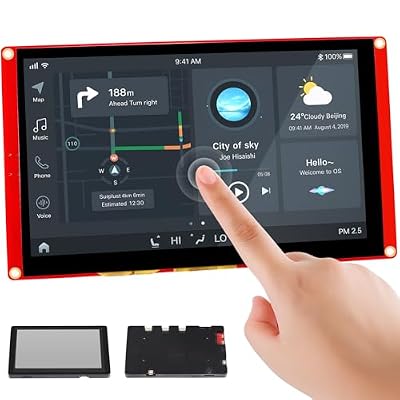
ELECROW 7-inch ESP32 HMI Touch Screen
The 7-inch ELECROW panel integrates an ESP32-S3 processor with WiFi and Bluetooth, suitable for complex industrial or automotive interfaces.
Read the details
Hosyond 1602 LCD Display Module (3-pack)
The 1602 LCD modules offer a straightforward I2C interface for displaying text, numbers, and clocks in IoT or educational projects.
Read the details
ELECROW 1.28-inch ESP32 Rotary Display
The 1.28-inch rotary display combines a touch screen with a physical knob, ideal for battery-powered smart home or portable control panels.
Read the detailsAll products, in detail

Hosyond 4.0-inch TFT Touch Screen
This 4.0-inch module features a 480×320 resolution with 65K color support and an integrated touch function. It uses an SPI serial bus, requiring only a few IO pins to operate, which simplifies wiring for compact projects. The unit includes an SD card slot and a touch pen, making it suitable for interactive interfaces.
It is compatible with Arduino R3, Nano, and Mega boards, and comes with sample programs and driver support to help developers get started quickly.
- 4.0-inch screen with 480×320 resolution and 65K color display
- Includes SD card slot and touch pen for interactive projects

HiLetgo 1.5-inch OLED Display Module
A compact 1.5-inch OLED module driven by the SH1107 chip, offering a 128×128 resolution in white. It supports both IIC and SPI interfaces, providing flexibility for different microcontroller setups. The high-contrast white display is ideal for small status indicators or data readouts. It is suitable for use with Arduino, Raspberry Pi, and STM32 boards, making it a versatile choice for hobbyists and engineers working with limited space.
- 1.5-inch OLED with 128×128 resolution and white display
- Supports both IIC and SPI interfaces for flexible integration

XIITIA 2.0-inch IPS TFT Display (2-pack)
This two-pack of 2.0-inch IPS TFT LCD modules offers a 240×320 resolution with 65K color support. The IPS panel provides an ultra-wide viewing angle, ensuring consistent color visibility from different perspectives. It uses a 4-wire SPI interface and is powered by 3.3V, making it easy to integrate into Arduino DIY projects.
The compact dimensions and full-color display make it suitable for small interactive devices or multi-screen setups.
- 2.0-inch IPS panel with 240×320 resolution and 65K colors
- Sold as a 2-pack with 4-wire SPI interface

Thermalright Trofeo Vision 6.86-inch LCD
A 6.86-inch full-color IPS LCD designed as a sub-display for PC cases, featuring a 1280×480 resolution. It uses a magnetic panel design that attaches without screws and connects via a single USB Type-C cable. The screen supports DIY dynamic and static images, system parameter monitoring, and video playback through the TRCC software.
It is compatible with the Trofeo Vision series liquid coolers and can be mounted on the side or bottom of the chassis.
- 6.86-inch IPS LCD with 1280×480 resolution and magnetic mounting
- Supports video playback and system monitoring via TRCC software

XIITIA 3.5-inch SPI TFT Display (2-pack)
This two-pack of 3.5-inch TFT LCD modules features a 320×480 resolution with full-color display. It supports SPI, 8-bit, and 16-bit parallel interfaces, offering flexibility for different controller capabilities. The modules operate within a temperature range of -20°C to 70°C and use the ST7796 driver IC.
With a module size of 59.19mm x 94.84mm, they are suitable for larger embedded displays or multi-screen configurations in Arduino projects.
- 3.5-inch TFT with 320×480 resolution and full-color display
- Supports SPI, 8-bit, and 16-bit parallel interfaces
Hosyond 1602 LCD Display Module (3-pack)
A three-pack of 1602 character LCD modules that display two lines of 16 characters each. These blue-backlit screens use an I2C serial interface, simplifying wiring to just four pins. Each module includes a built-in potentiometer for adjusting backlight brightness. They are compatible with Arduino, Raspberry Pi, and other development boards, making them ideal for IoT projects, smart buildings, and educational electronics where text-based data display is required.
- 16×2 character LCD with I2C interface and blue backlight
- Sold as a 3-pack with built-in backlight potentiometer
ELECROW 7-inch ESP32 HMI Touch Screen
This 7-inch TFT LCD touch screen integrates an ESP32-S3-WROOM-1-N4R8 controller with a dual-core 32-bit LX7 processor running up to 240MHz. It features an 800×480 resolution and supports WiFi and Bluetooth connectivity. The module includes a TF card slot, USB, speaker, and battery interfaces, and is compatible with Arduino, LVGL, and MicroPython.
It is designed for automotive HMI, medical equipment, and industrial control applications, with an acrylic case for protection.
- 7-inch TFT with 800×480 resolution and ESP32-S3 dual-core processor
- Integrates WiFi, Bluetooth, and multiple expansion interfaces
ELECROW 1.28-inch ESP32 Rotary Display
A compact 1.28-inch round IPS display with 240×240 resolution, featuring a rotary knob and capacitive touch interface. It is powered by an ESP32-S3 dual-core processor and supports 2.4G WiFi and BLE for IoT applications. The knob allows for clockwise, counterclockwise, and full-press actions, ideal for adjusting volume or menus.
The low-power design and ambient light effect make it suitable for portable devices, smart home controls, and educational projects.
- 1.28-inch round IPS display with 240×240 resolution and rotary knob
- Features ESP32-S3 processor with WiFi and BLE connectivity
Head-to-Head Comparisons
ELECROW 7-inch HMI vs 1.28-inch Rotary Display
The ELECROW 7-inch HMI and the 1.28-inch rotary display both use the ESP32-S3 processor but serve different use cases. The 7-inch panel offers an 800×480 resolution and a larger touch area, making it suitable for complex user interfaces in automotive or industrial settings. It includes a TF card slot and speaker interface for multimedia applications.
In contrast, the 1.28-inch rotary display is a compact round screen with a physical knob, designed for portable, battery-powered devices where space is limited. The larger panel provides more screen real estate for detailed data, while the smaller knob display excels in simple, tactile control scenarios.
Hosyond 1602 LCD vs HiLetgo 1.5-inch OLED
The Hosyond 1602 LCD and the HiLetgo 1.5-inch OLED are both compact displays but differ in output type and interface. The 1602 LCD displays two lines of 16 characters using an I2C interface, making it ideal for text-based data like temperature or time. It is a three-pack, allowing for multi-screen setups.
The HiLetgo OLED is a 1.5-inch monochrome screen with 128×128 resolution, supporting both IIC and SPI interfaces. It offers higher pixel density for graphical elements but lacks the multi-line text convenience of the character LCD. Choose the LCD for simple text readouts and the OLED for small graphical indicators.
XIITIA 2.0-inch vs 3.5-inch TFT Displays
Both XIITIA TFT displays are sold as two-packs and use SPI interfaces, but they differ in size and resolution. The 2.0-inch model features a 240×320 resolution and an IPS panel for wide viewing angles, suitable for small interactive devices. The 3.5-inch model offers a 320×480 resolution and supports SPI, 8-bit, and 16-bit parallel interfaces, providing more flexibility for controllers with more available pins.
The larger 3.5-inch screen provides more display area for complex UIs, while the 2.0-inch IPS panel is better for applications where viewing angle is critical. Both are compatible with Arduino DIY projects.
Buying Guide
Interface Compatibility
Check the interface type of your microcontroller before selecting a display. SPI interfaces are common for TFT and OLED modules, requiring fewer pins than parallel connections. I2C is ideal for character LCDs, simplifying wiring to four pins. If your board has limited IO, consider modules with integrated controllers like the ESP32 displays, which handle communication internally.
Ensure your power supply matches the display's voltage requirements, as some modules operate at 3.3V while others support 5V.
Resolution and Screen Size
Match the screen size and resolution to your application's needs. Character LCDs are best for simple text data, while TFT and OLED panels support graphical interfaces. For industrial HMIs, higher resolutions like 800×480 provide clarity for detailed dashboards. For portable devices, smaller screens like 1.28-inch or 1.5-inch save space and power.
Consider the viewing angle if the display will be seen from multiple positions; IPS panels offer wider angles than standard TFTs.
Connectivity and Expansion
Determine if your project requires wireless connectivity or additional peripherals. ESP32-based displays integrate WiFi and Bluetooth, enabling IoT applications without extra modules. Check for expansion interfaces like USB, UART, or I2C if you need to connect sensors or other devices. For PC case displays, ensure compatibility with your motherboard's USB headers.
If you plan to use multiple displays, verify that your controller can handle the data bandwidth required for simultaneous operation.
Power and Environmental Factors
Consider the operating environment and power source for your display. For battery-powered portable devices, choose low-power designs like the 1.28-inch rotary display. Check the operating temperature range if your device will be used in extreme conditions; some modules support -20°C to 70°C. Ensure your power supply can handle the backlight current, especially for larger TFT panels.
For outdoor or industrial use, consider displays with protective cases or higher durability ratings.
Frequently Asked Questions
Can I use these displays with Raspberry Pi?
Yes, many of these modules are compatible with Raspberry Pi. The HiLetgo OLED and Hosyond 1602 LCD explicitly list Raspberry Pi compatibility. The ESP32 displays can also be used with Raspberry Pi via USB or UART, though they are primarily designed for standalone operation. Check the specific interface requirements for each module.
Do the ESP32 displays require a separate power supply?
The ELECROW 7-inch HMI includes a battery interface and USB power, allowing it to run standalone or connected to a computer. The 1.28-inch rotary display has a 5V charging interface for power and programming. Most other modules require a 3.3V or 5V power supply from your microcontroller or external source.
Check the specific voltage requirements for each product.
Are the TFT displays touch-enabled?
The Hosyond 4.0-inch TFT and the ELECROW 7-inch HMI are touch-enabled. The XIITIA 2.0-inch and 3.5-inch TFTs, as well as the HiLetgo OLED and Hosyond 1602 LCD, are not touch-enabled based on the provided descriptions. The ELECROW 1.28-inch rotary display features capacitive touch and a rotary knob.
Verify the specific model if touch functionality is required.
Can I use multiple displays in one project?
Yes, you can use multiple displays if your microcontroller has sufficient IO pins and processing power. The XIITIA and Hosyond modules are sold in multi-packs, making them convenient for multi-screen setups. For ESP32 displays, you can connect multiple units via USB or UART, but ensure your controller can handle the data bandwidth.
Check the interface requirements for each display to ensure compatibility.
This article is part of our complete guide Electronics — browse all our comparisons and buying guides.
Last update on 2026-11-18 / Affiliate links / Images from Amazon Product Advertising API