
Selecting the right science lab light source depends on the specific optical principles you wish to demonstrate and the age of your students. Some kits focus on the basics of color mixing and reflection for younger learners, while others provide complex bench setups for advanced physics experiments.
This comparison examines six distinct options, ranging from simple LED ray boxes to magnetic laser systems and fruit battery circuits. Each product serves a different educational purpose, helping you find the tool that best fits your curriculum or home learning goals.
Our pick: Tech Light Lab LED Color Mixing Kit. The Tech Light Lab kit is designed for grades 2-8, making it suitable for younger students learning basic reflection and color mixing.
Our 3 picks for different needs

Tech Light Lab LED Color Mixing Kit
The Tech Light Lab kit is designed for grades 2-8, making it suitable for younger students learning basic reflection and color mixing.
Read the details
EXBEPE Magnetic Physics Optical Experiment Kit
The EXBEPE kit uses magnetic components that attach to whiteboards, ideal for large classroom demonstrations of laser optics.
Read the details
Physics Optics Experiment Kit with 60cm Bench
The Physics Optics Experiment Kit includes a 60cm optical bench and extensive components for detailed, structured lab work.
Read the detailsAll products, in detail
Tech Light Lab LED Color Mixing Kit
This kit is designed for grades 2-8, focusing on the fundamentals of light, reflection, and refraction. It includes durable LEDs in the three primary colors of light, along with lenses and mirrors. The Light Blox components double as ray boxes when capped, projecting visible beams for exploration.
This setup makes abstract concepts concrete for younger students. It is a strong choice for early education settings where simplicity and safety are priorities.
- Includes LEDs in red, green, and blue primary colors
- Designed specifically for students in grades 2-8
Physics Optics Experiment Kit with 60cm Bench
This comprehensive kit includes a 60cm integrated optical bench that requires no assembly. It features three bright, adjustable light sources and a wide array of components like acrylic prisms, lenses, and a simulated eyeball card. The kit supports a broad range of experiments, from plane mirror reflection to pinhole imaging.
It is suitable for home, lab, or institutional use. The inclusion of a storage box and manual makes it a ready-to-use solution for structured STEM curricula.
- Features a 60cm integrated optical bench
- Includes acrylic prisms and lenses for light transmittance

Baluue Three-Way Semiconductor Light Source
This compact apparatus measures approximately 4.13 by 2.76 by 2.36 inches and weighs about 6.1 ounces. It is a lightweight tool designed for quick setup in physics classrooms. The device is specifically built for demonstrating reflection, diffraction, and refraction. Its portable nature makes it suitable for field studies or small desks.
It serves as a focused educational tool for visualizing light travel principles without the bulk of a full bench kit.
- Measures approximately 4.13 by 2.76 by 2.36 inches
- Weighs approximately 6.1 ounces
EXBEPE Magnetic Physics Optical Experiment Kit
This kit utilizes a magnetic design, allowing all accessories to attach to classroom blackboards or whiteboards. It includes a triple laser light source with independent switches for multi-beam experiments. Components include various magnetic lenses, prisms, and reflectors. This setup is ideal for large-group demonstrations where visibility on a board is key.
The magnetic attachment simplifies the arrangement of optical paths for teaching reflection and refraction.
- Accessories magnetically attach to blackboards or whiteboards
- Includes a triple laser light source with independent switches
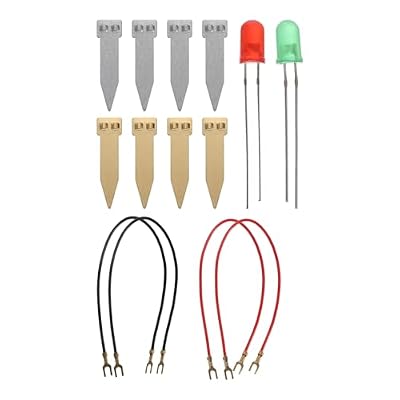
PATIKIL Fruit Battery Science Kit (2 Set)
This kit focuses on simple circuit knowledge using fruit batteries. It includes two sets of components made of plastic and metal. Users can assemble batteries using fruits like lemons, potatoes, or oranges to light up RGB LEDs. It is a hands-on tool for exploring basic physics and electricity.
The kit is suitable for home or teaching environments where the goal is to understand how chemical energy converts to light. It provides a distinct entry point into science experiments.
- Includes 2 sets of fruit battery light science kits
- Works with fruits like orange, potato, or lemon

Hohopeti 10 Pcs Three Light Source Optics Kit
This teaching instrument features a three-way semiconductor light source designed for physics classroom use. It is a plastic white apparatus intended for optics experiments and light circuits. The kit is described as a school teaching tool that helps cultivate scientific knowledge through interactive play. It provides a simple operation interface for conducting experiments.
It is a straightforward option for educators looking for a basic light source apparatus for their labs.
- Features a three-way semiconductor light source
- Constructed from plastic with a white finish
Head-to-Head Comparisons
Tech Light Lab vs Physics Optics Kit: Simplicity vs Complexity
The Tech Light Lab kit is tailored for grades 2-8, focusing on concrete, hands-on exploration of reflection and refraction using LED ray boxes. It is designed to be easy to teach and learn, removing the need for expensive equipment. In contrast, the Physics Optics Experiment Kit offers a 60cm integrated optical bench and a wide variety of components, including a simulated eyeball card and multiple lenses.
This makes it better suited for more complex, structured experiments. If you are teaching younger students the fundamentals, the Tech Light Lab is more appropriate. If you need a comprehensive tool for advanced optics, the Physics Optics Kit provides the necessary depth.
EXBEPE Magnetic Kit vs Baluue Compact Source: Display vs Portability
The EXBEPE Magnetic Physics Optical Experiment Kit is designed for classroom blackboards or whiteboards, using magnetic attachments to hold lenses and prisms. This is ideal for large-group demonstrations where visibility is paramount. The Baluue Three-Way Semiconductor Light Source, however, is a compact, portable unit measuring just over 4 inches.
It is lightweight and easy to carry, making it suitable for individual desks or field studies. The EXBEPE kit prioritizes display capability with its triple laser source, while the Baluue unit prioritizes ease of transport and simple setup for smaller spaces.
PATIKIL Fruit Battery vs Hohopeti Light Source: Circuits vs Optics
The PATIKIL Fruit Battery Science Kit focuses on simple circuit knowledge, using fruits to power RGB LEDs. It is a tool for understanding electricity and chemical energy conversion. The Hohopeti 10 Pcs kit, on the other hand, is a three-way semiconductor light source specifically for optics experiments and light circuits.
While both are educational tools, the PATIKIL kit is better for introductory physics regarding power sources. The Hohopeti kit is more focused on the behavior of light itself. Choose the PATIKIL kit for circuit basics and the Hohopeti kit for dedicated optics experiments.
Buying Guide
Match the Light Source to the Age Group
Consider the grade level of your students when selecting a kit. The Tech Light Lab is explicitly designed for grades 2-8, making it a safe and simple entry point for younger learners. For older students or those in high school physics, kits with more complex components like the Physics Optics Experiment Kit or the EXBEPE magnetic system may be more appropriate.
Ensuring the complexity of the tool matches the student's developmental stage helps maintain engagement and understanding.
Determine the Primary Educational Goal
Decide whether you want to teach optics, electricity, or general science. If your goal is to demonstrate refraction and reflection, look for kits with prisms and lenses, such as the Baluue or EXBEPE options. If you want to teach basic circuits, the PATIKIL fruit battery kit is a distinct choice.
Clarifying your primary learning objective ensures you select a tool that directly supports your curriculum rather than a general-purpose set that may not cover your specific needs.
Assess the Classroom or Home Space
Evaluate where the experiments will take place. The EXBEPE kit is designed for whiteboards, making it ideal for traditional classrooms with large display surfaces. The Baluue unit is compact and portable, suitable for small desks or field trips. The Physics Optics Kit requires a stable surface for its 60cm bench.
If you are working in a home environment with limited space, a compact source or a magnetic board kit may be more practical than a full bench setup.
Check for Included Components and Accessories
Review what is included in the box to avoid additional purchases. The Physics Optics Kit includes a storage box, manual, and a wide range of lenses and mirrors. The EXBEPE kit includes a 360-degree angle diagram and various magnetic lenses. The Tech Light Lab includes caps that turn the LEDs into ray boxes.
Knowing exactly what components are provided helps you plan your lessons and ensures you have the necessary tools for the specific experiments you intend to perform.
Frequently Asked Questions
Are these light sources safe for young children?
The Tech Light Lab is designed for grades 2-8 and uses LEDs, which are generally safe for this age group. The fruit battery kit uses plastic and metal components. Always supervise young children during any science experiment to ensure they handle the tools correctly and safely.
Can I use these kits for home learning?
Yes, several options are suitable for home use. The Physics Optics Kit is described as working at home, labs, or institutions. The Baluue unit is compact and portable. The fruit battery kit is also great for home teaching. Check the specific dimensions and setup requirements to ensure they fit your home space.
Do these kits require batteries?
The Tech Light Lab and EXBEPE kits use electronic light sources, likely requiring power. The fruit battery kit uses fruits to generate power. The specific power requirements for the semiconductor sources are not detailed in the provided data, so you should check the product listing for battery needs.
What is the difference between a laser and an LED source?
The EXBEPE kit uses a triple laser source, which provides coherent beams for precise optics demonstrations. The Tech Light Lab uses LEDs in primary colors, which are better for color mixing and general ray tracing. Lasers are often used for more advanced physics, while LEDs are common for introductory color theory.
This article is part of our complete guide Toys & Games — browse all our comparisons and buying guides.
Last update on 2026-11-18 / Affiliate links / Images from Amazon Product Advertising API