
Selecting the right lab syringe pump depends on your specific volume requirements, channel needs, and control preferences. Whether you are performing simple single-syringe dispensing or complex multi-channel automated workflows, the available options vary significantly in their mechanical and digital capabilities.
This comparison examines eight distinct devices, ranging from basic single-channel units to advanced multi-channel systems with extensive communication interfaces. By focusing on documented features like syringe compatibility, motor resolution, and display types, you can identify the tool that best fits your experimental design.
Our pick: 3-Channel Lab Syringe Pump. The 3-channel configuration allows for parallel liquid dispensing, which is useful for experiments requiring synchronized delivery across multiple samples.
Our 3 picks for different needs

3-Channel Lab Syringe Pump
The 3-channel configuration allows for parallel liquid dispensing, which is useful for experiments requiring synchronized delivery across multiple samples.
Read the details
iDili Laboratory Micropump with Foot Pedal
With 3200 steps per revolution and multiple communication protocols, this pump offers fine-grained control for automated lab workflows.
Read the details
Yokoma Laboratory Microinjection Pump
Its compact size and lightweight design make it suitable for users who need to move the pump between different lab stations or field locations.
Read the detailsAll products, in detail
3-Channel Lab Syringe Pump
This three-channel apparatus is designed for simultaneous liquid dispensing across multiple syringes. The controller supports syringe sizes ranging from 1 ml to 50 ml, automatically switching units after selection. It features an 8mm stainless steel guide rail and a 42-step motor with 400 steps per revolution.
The 1602 LCD display allows users to set speed, time, and mode. An RS-232 interface enables connection to computers or PLCs for automated control.
- Supports 3 independent channels for simultaneous dispensing
- Includes RS-232 interface for computer or PLC control

Desktop Syringe Injection Pump 1ml-150ml
This desktop unit handles a wide range of syringe sizes from 1 ml to 150 ml, making it suitable for larger volume dispensing tasks. It utilizes a 42-step motor with 400 steps per turn and an 8mm stainless steel guide rail for stability. The controller features a 1602 LCD display with buttons for speed and mode settings.
It includes a TTL level RS-232 interface and supports external switches or foot pedals for hands-free operation.
- Compatible with syringes up to 150 ml capacity
- Features a 1602 LCD display with manual control buttons
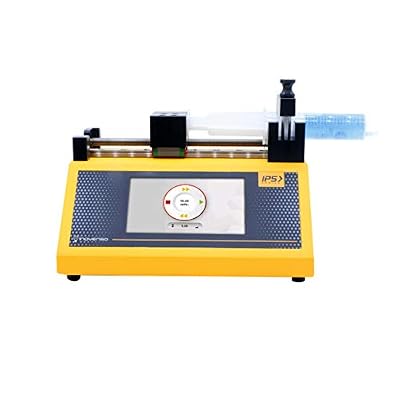
IPS-12 Single Injector Syringe Pump
The IPS-12 is a single-channel pump designed for infusion mode in veterinary and laboratory settings. It features a 4.3-inch resistive touch TFT LCD screen for a user-friendly interface. The microcontroller software allows for high-precision pumping with adjustable flow rates even during the process. This non-medical device is suitable for research applications requiring consistent fluid delivery from a single syringe.
- Single channel design for one syringe at a time
- 4.3-inch resistive touch TFT LCD screen

IPS-14RS Double Channel Syringe Pump
This model offers two independent pump channels with five operation modes. It supports both infusion and withdrawal, allowing for forward and backward fluid movement. Users can save and recall up to five recipes for repeatable experiments. The 4.3-inch touch screen and microcontroller software provide precise control.
It is designed for veterinary and laboratory use where dual-channel coordination is required.
- Double independent channels with 5 operation modes
- Supports saving and recalling up to 5 recipes

IPS-14R Double Channel Syringe Pump
The IPS-14R features two independent channels capable of infusion and withdrawal. It uses a 4.3-inch resistive touch TFT LCD screen for parameter adjustment. The microcontroller software ensures high-precision pumping with adjustable flow rates during operation. This non-medical syringe pump is intended for laboratory and veterinary applications requiring dual-channel control.
- Independent double channels for infusion and withdrawal
- 4.3-inch resistive touch TFT LCD screen
IPS-12S Smart Single Syringe Pump
This smart pump accommodates a single syringe with a secure mounting system. It features an intuitive LCD display with easy-to-navigate controls for precise operation. The device operates on a 12V DC power supply with plug-and-play functionality and grounding capability. It is designed for consistent fluid delivery in lab research, offering a compact solution for single-channel dispensing tasks.
- Operates on 12V DC power supply
- Single syringe design with secure mounting
iDili Laboratory Micropump with Foot Pedal
This precision desktop pump features a 42-step motor with 3200 steps per turn for fine control. The piston fixing part is adjustable for different syringe specifications. It includes a new controller that allows switching between mm/time and ml/time units. The unit supports various communication protocols including USB, TTL, 232, 485, and CAN, as well as mobile phone control.
It comes with a foot pedal set for hands-free operation.
- 42-step motor with 3200 steps per revolution
- Supports USB, TTL, 232, 485, and CAN communication
Yokoma Laboratory Microinjection Pump
This compact microinjection pump is designed for syringes with a diameter of 1.9 inches or below. It features a multifunctional controller with an LCD display that stores parameters even when powered off. The structure uses 8mm thickened 304 stainless steel guide rails and a transparent acrylic bracket for easy observation.
The unit is lightweight and portable, measuring 12.6 x 3.9 x 5.9 inches, making it easy to move between workstations.
- Compatible with syringes 1.9 inches or below in diameter
- Transparent acrylic bracket for observing the work process
Head-to-Head Comparisons
3-Channel Precision vs Large Volume Desktop Pump
The 3-Channel Lab Syringe Pump and the Desktop Syringe Injection Pump both use 42-step motors with 400 steps per revolution and 8mm stainless steel guide rails. However, their primary use cases differ. The 3-Channel model is built for simultaneous dispensing across three syringes, supporting sizes from 1 to 50 ml.
In contrast, the Desktop model focuses on a single channel but supports a much wider range, from 1 to 150 ml. If your experiment requires parallel processing of multiple small samples, the 3-Channel unit is the logical choice. If you need to dispense larger volumes from a single syringe, the Desktop model offers the necessary capacity.
IPS-12 Single Channel vs IPS-14RS Double Channel
Both the IPS-12 and IPS-14RS feature 4.3-inch resistive touch TFT LCD screens and microcontroller software for precise pumping. The key distinction is channel count and functionality. The IPS-12 is a single-channel device designed for infusion mode. The IPS-14RS offers two independent channels with five operation modes, supporting both infusion and withdrawal.
It also allows users to save and recall up to five recipes. For simple, single-syringe tasks, the IPS-12 is sufficient. For experiments requiring coordinated dual-channel movement or repeatable recipe execution, the IPS-14RS provides the necessary flexibility.
iDili High-Resolution Pump vs Yokoma Portable Micro Pump
The iDili Laboratory Micropump and the Yokoma Microinjection Pump both feature 8mm stainless steel guide rails and LCD controllers. The iDili model uses a 42-step motor with 3200 steps per turn, offering higher resolution than the Yokoma's unspecified step count. The iDili also supports a wide array of communication protocols including USB, TTL, 232, 485, and CAN.
The Yokoma pump is distinguished by its compact, portable design with a transparent acrylic bracket and a limit of 1.9 inches for syringe diameter. Choose the iDili for complex automated control and high precision. Choose the Yokoma for portability and ease of visual monitoring in a compact setup.
Buying Guide
Channel Count and Syringe Capacity
Determine how many syringes you need to operate simultaneously. Single-channel pumps like the IPS-12 are ideal for basic dispensing. Multi-channel units, such as the 3-Channel Lab Syringe Pump, allow for parallel experiments. Also consider the maximum syringe size required; the Desktop Syringe Injection Pump supports up to 150 ml, while the Yokoma pump is limited to syringes 1.9 inches or below in diameter.
Matching the pump's mechanical range to your specific syringe inventory is critical for compatibility.
Control Interface and Automation
Evaluate how you will control the pump. Basic models use physical buttons and LCD displays for manual operation. Advanced models offer digital interfaces for automation. The iDili Micropump supports USB, TTL, 232, 485, and CAN communication, allowing integration with computers and PLCs. The IPS series uses touch screens for user-friendly manual control.
If your workflow involves automated sequences or remote monitoring, prioritize pumps with robust communication protocols. For manual, hands-on operation, a simple button-based interface may be sufficient.
Motor Resolution and Precision
Motor resolution, measured in steps per revolution, affects the granularity of fluid delivery. The iDili Micropump uses a 42-step motor with 3200 steps per turn, providing fine control for micro-dispensing. Other models, such as the 3-Channel and Desktop pumps, use 400 steps per revolution. Higher step counts generally allow for smaller, more precise increments of fluid movement.
If your experiments require high-precision dosing, look for pumps with higher step resolutions. For general dispensing tasks, standard resolution may be adequate.
Portability and Physical Design
Consider where the pump will be used. The Yokoma Microinjection Pump is designed for portability, with a compact size and lightweight construction. It features a transparent acrylic bracket that allows you to observe the syringe movement. Other models are designed as desktop units with more robust structures.
If you need to move the pump between different lab stations or use it in field settings, prioritize compact, lightweight designs. For fixed benchtop use, a larger, more stable structure may be preferable.
Frequently Asked Questions
What is the difference between infusion and withdrawal modes?
Infusion mode pushes fluid out of the syringe, while withdrawal mode pulls fluid back in. Pumps like the IPS-14RS support both modes, allowing for bidirectional fluid movement. This is useful for experiments requiring mixing or sampling. Single-mode pumps, like the IPS-12, only support infusion.
Can these pumps be controlled by a computer?
Yes, several models support computer control. The iDili Micropump and the 3-Channel Lab Syringe Pump feature RS-232 interfaces. The iDili model also supports USB, TTL, 485, and CAN protocols. These interfaces allow you to send commands from a computer or PLC to automate the dispensing process.
What syringe sizes are compatible with these pumps?
Compatibility varies by model. The Desktop Syringe Injection Pump supports 1 to 150 ml syringes. The 3-Channel pump supports 1 to 50 ml. The Yokoma pump is limited to syringes 1.9 inches or below in diameter. Always check the specific model's specifications to ensure your syringes fit the clamping mechanism.
Do these pumps have memory for saved settings?
Some models do. The IPS-14RS allows users to save and recall up to five recipes. The Yokoma pump stores parameters even when powered off. Other models may not have explicit recipe storage features. If you need to repeat complex sequences, look for pumps with recipe or parameter memory capabilities.
This article is part of our complete guide Toys & Games — browse all our comparisons and buying guides.
Last update on 2026-11-21 / Affiliate links / Images from Amazon Product Advertising API