
Choosing the right stud finder depends on the specific tasks you plan to perform, such as hanging heavy shelves or installing cabinets. Different models offer varying levels of sensor accuracy, depth detection, and display features.
This comparison examines eight stud finder scanners, highlighting their sensor counts, depth capabilities, and additional features like laser levels and live wire detection. By understanding these differences, you can select a tool that fits your specific home improvement needs.
Our pick: Franklin Sensors ProSensor M210. The Franklin Sensors ProSensor M210 requires no calibration and uses 13 sensors to display the full width of studs.
Our 3 picks for different needs

Franklin Sensors ProSensor M210
The Franklin Sensors ProSensor M210 requires no calibration and uses 13 sensors to display the full width of studs.
Read the details
PREXISO 2-in-1 Stud Finder with Laser Level

The PREXISO 2-in-1 tool combines stud detection with a manual laser level for marking lines.
Read the details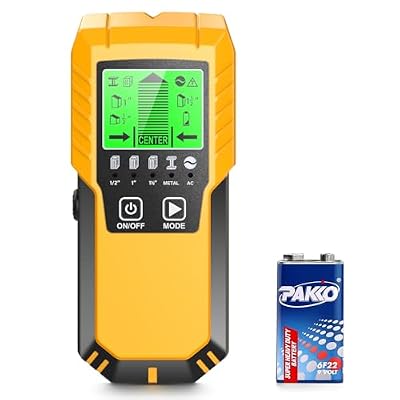
Povlen Stud Finder Wall Scanner
The Povlen stud finder offers five distinct modes with specific depth ranges for wood, metal, and AC wires.
Read the detailsAll products, in detail
Franklin Sensors ProSensor M210
The ProSensor M210 features 13 sensors for high accuracy and requires no calibration before scanning. It displays the full width of studs and double studs on an LED screen, with a green light indicating the center. Deep scan is always active, detecting wood and metal studs up to 1.7 inches deep.
It includes live wire detection, a built-in bubble level, and a pencil caddy. This model is suitable for users who want a comprehensive display and do not want to calibrate before every scan. It uses two AA batteries, which are not included but can be rechargeable.
- 13 sensors with no calibration required
- Deep detection up to 1.7 inches

Upgranded Wood and Metal Stud Detector
This Upgranded stud finder uses an intelligent micro-sensor chip to locate edges and centers of studs, joists, pipes, and live AC wires. It features a bright, backlit LCD display that shows stud location and battery status, along with audio alerts. The device offers multiple scan modes, including stud, deep, and metal scans, allowing users to detect various materials at different depths.
It is designed for use in walls, floors, and ceilings, making it a versatile option for hanging heavy objects or installing fixtures. The backlit display aids visibility in low-light settings.
- Backlit LCD display with audio alerts
- Multiple scan modes for wood, metal, and deep objects
PREXISO 2-in-1 Stud Finder with Laser Level
The PREXISO tool combines a rechargeable stud finder with a manual-leveling cross line laser. It detects wood and metal studs up to 3/4 inch deep and AC wires up to 1-1/2 inches. When a stud edge is found, it auto-projects a vertical laser line and sounds an audio alert for precise marking.
The laser level is manual, requiring the user to align bubble vials for horizontal or vertical lines. It includes a 360-degree wall mount and self-adhesive strips for positioning. This tool is ideal for users who need both stud detection and line marking in a single device.
- Combines stud finder and manual laser level
- Auto-projects laser line at stud edges

Upgranded Wood and Metal Stud Detector
This Upgranded stud finder utilizes a micro-sensor chip to quickly find edges and centers of metal, studs, joists, pipes, and live AC wires. It features a high-visibility, backlit LCD display that indicates the center, edge, and location of detected objects, as well as battery status.
Audio alerts and beep sounds guide the user to the exact stud location. The device offers stud, deep, and metal scan modes to handle different materials and depths. It is a practical tool for homeowners and DIY enthusiasts who need to hang shelves or install cabinets without damaging walls.
- Backlit LCD display with battery status
- Stud, deep, and metal scan modes

Franklin Sensors ProSensor M150
The ProSensor M150 includes 9 sensors and requires no calibration, allowing users to start scanning anywhere on the wall. It displays the full width of studs and double studs on an LED screen, with a green light marking the center. Deep scan is always on, detecting wood and metal studs up to 1.5 inches deep.
It includes live wire detection for safety during drilling. This model uses two AAA batteries, which are not included and are not compatible with rechargeable batteries. It is a good choice for users who prefer a compact sensor array and standard battery power.
- 9 sensors with no calibration required
- Deep detection up to 1.5 inches
Povlen Stud Finder Wall Scanner
The Povlen stud finder offers five scanning modes for different needs, including three stud modes, a metal mode, and an AC mode. It detects studs up to 1.5 inches deep, metal up to 2.36 inches, and AC wires up to 2 inches. The device features a shock-resistant and dust-resistant design for durability.
A bright, backlit LCD display shows the center and edge of studs, accompanied by audio alerts. It provides continuous wire alerts in all modes to help users avoid drilling into live wires. This model is suitable for users who need specific depth ranges for different materials.
- Five scanning modes with specific depth ranges
- Continuous wire alerts in all modes

Onion Stud Finder
The Onion stud finder is listed with minimal descriptive details in the provided data. The title identifies it as a stud finder, but specific features such as sensor count, depth range, display type, or battery requirements are not documented in the source material. Buyers should review the full product listing for detailed specifications before purchase.
This entry is included to complete the set of eight available options in this comparison. Without additional feature data, it is difficult to compare its capabilities against the other listed models.
- Listed as a stud finder
- Specific features not detailed in source

CRAFTSMAN Stud Finder CMHT77633
The CRAFTSMAN stud finder has a depth range of 3/4 inch through drywall and works on surfaces covered in wallpaper and fabric. It features edge detection to locate the edges of both wood and metal studs. The body is shock-resistant and water-resistant for durability. It is designed for common applications such as locating studs in walls.
The package includes one CMHT77633 stud sensor. This model is a straightforward option for users who need basic edge detection on standard drywall or covered surfaces.
- 3/4 inch depth range through drywall
- Works on wallpaper and fabric surfaces
Head-to-Head Comparisons
Franklin Sensors ProSensor M210 vs M150
Both Franklin Sensors models require no calibration and display the full width of studs. The ProSensor M210 features 13 sensors and detects studs up to 1.7 inches deep, while the M150 has 9 sensors and detects up to 1.5 inches. The M210 includes a built-in bubble level and is compatible with rechargeable AA batteries.
The M150 uses AAA batteries that are not compatible with rechargeable types. If you need the deepest detection range and a bubble level, the M210 is the better fit. If you prefer AAA batteries, the M150 is the option.
PREXISO 2-in-1 vs Upgranded Stud Detector
The PREXISO tool combines a stud finder with a manual laser level, allowing for line marking in addition to stud detection. It detects wood and metal studs up to 3/4 inch deep. The Upgranded detector focuses solely on stud finding but offers multiple scan modes including deep and metal scans.
It features a backlit LCD display and audio alerts. If you need to project lines for hanging pictures or installing shelves, the PREXISO is the more versatile choice. If you only need to locate studs and prefer a dedicated scanner, the Upgranded model is suitable.
Povlen Stud Finder vs CRAFTSMAN Stud Finder
The Povlen stud finder offers five scanning modes with specific depth ranges, detecting metal up to 2.36 inches and AC wires up to 2 inches. It features a backlit LCD display and continuous wire alerts. The CRAFTSMAN model has a simpler 3/4 inch depth range and works on wallpaper and fabric surfaces.
It is shock and water-resistant. The Povlen is better for users who need to detect deeper metal objects and live wires with specific mode settings. The CRAFTSMAN is a straightforward option for basic stud edge detection on covered surfaces.
Buying Guide
Sensor Count and Calibration
Some stud finders require calibration before each scan, while others do not. Models like the Franklin Sensors ProSensor series do not require calibration, allowing you to start scanning anywhere on the wall. This can save time and reduce the chance of false readings. If you prefer a no-calibration process, look for models that explicitly state this feature.
Calibration-free tools are often easier for beginners to use consistently.
Depth Detection Capabilities
Depth detection varies significantly between models. Some finders detect studs up to 3/4 inch, while others go up to 1.7 inches or more. If you are working with thicker drywall or need to detect deeper metal objects, a higher depth range is beneficial. Check the specific depth ratings for wood and metal studs, as they may differ.
Deeper detection is useful for finding pipes and wires behind walls.
Display and Alert Types
Stud finders use different display types, including LED lights, backlit LCD screens, and laser projections. LED displays often show the full width of the stud, while LCD screens provide more detailed information like battery status. Audio alerts are common and help guide you to the stud center.
If you work in low-light conditions, a backlit display is advantageous. Laser levels add the ability to mark lines, which is useful for alignment tasks.
Battery Type and Power
Battery requirements vary by model. Some use AA or AAA batteries, while others are rechargeable via USB. Check if the model is compatible with rechargeable batteries, as this can be more convenient for frequent use. Some models specify that they are not compatible with rechargeable batteries.
Knowing the battery type helps you plan for power sources during long projects. Rechargeable models often come with a charging cable in the package.
Frequently Asked Questions
Do I need to calibrate a stud finder before every scan?
It depends on the model. Some stud finders, like the Franklin Sensors ProSensor series, do not require calibration and can be scanned from anywhere. Others may require you to place the device on a known empty area of the wall to calibrate. Check the specific instructions for your chosen model.
Can stud finders detect live wires?
Many modern stud finders include live wire detection features. This alerts you when the device is near an energized AC wire, helping you avoid drilling into it. Look for models that explicitly mention live wire or AC wire detection in their features.
What is the difference between wood and metal stud detection?
Wood detection identifies wooden studs, while metal detection identifies metal studs, pipes, or other metal objects. Some models have separate modes for each, while others detect both in a single mode. Check the depth ratings for each material, as they may differ.
Can I use a stud finder on wallpaper or fabric?
Some stud finders are designed to work through surfaces like wallpaper and fabric. The CRAFTSMAN model, for example, specifies that it works on surfaces covered in wallpaper and fabric. Other models may not specify this capability. If you are working on covered walls, verify that the model supports these surfaces.
This article is part of our complete guide Tools & Home Improvement — browse all our comparisons and buying guides.
Last update on 2026-11-19 / Affiliate links / Images from Amazon Product Advertising API