
Selecting the right temperature calibrator depends on whether you need a handheld field tool or a benchtop dry-block reference. Handheld units are designed for portability and quick checks on thermocouples and process loops, while dry-blocks provide a stable thermal environment for precise laboratory calibration.
The options in this comparison range from multifunction process calibrators with loop power to high-temperature dry-blocks. Each tool serves a specific workflow, from verifying PLC inputs to calibrating sensors in industrial ovens. Understanding the specific sensor types and temperature ranges required for your application is the first step in choosing the correct instrument.
Our pick: Triplett PCAL100 High Precision Temp Calibrator. The Triplett PCAL100 offers 0.05% accuracy and supports both RTD and thermocouple sensors, making it ideal for critical field applications.
Our 3 picks for different needs

Triplett PCAL100 High Precision Temp Calibrator

The Triplett PCAL100 offers 0.05% accuracy and supports both RTD and thermocouple sensors, making it ideal for critical field applications.
Read the details
eC370T Volt mA Thermocouple Loop Process Calibrator
The ennoLogic eC370T includes a built-in 24V loop supply, simplifying the testing of 2-wire current loops and PLC inputs.
Read the details
INSTRUKART AI-DBC-02 Dry Block Temperature Calibrator
The INSTRUKART AI-DBC-02 reaches 650°C, providing a stable dry-block reference for high-heat calibration tasks.
Read the detailsAll products, in detail
Triplett PCAL100 High Precision Temp Calibrator
The Triplett PCAL100 is a handheld unit designed for high-precision field work. It supports 11 thermocouple types and 5 RTD types, allowing technicians to handle a wide variety of sensors without swapping tools. With source and measure accuracy up to 0.05%, it is suitable for critical applications where data reliability is paramount.
The device includes adjustable temperature compensation and multi-wire resistance measurement capabilities, making it a versatile choice for industrial maintenance teams.
- Supports 11 thermocouple types and 5 RTD types
- Source and measure accuracy up to 0.05%
eC370T Volt mA Thermocouple Loop Process Calibrator
The ennoLogic eC370T is a process calibrator that combines voltage, current, and temperature functions. It features a built-in 24V loop supply, which simplifies testing 2-wire current loops by powering the device under test directly. Users can configure hotkeys for rapid signal output and utilize ramp and ladder functions for dynamic testing.
This unit is ideal for engineers who need to verify PLC inputs and transmitter outputs in a single handheld package.
- Includes built-in 24V loop supply for 2-wire transmitters
- Measures thermocouple temperatures from -250°C to +1800°C

Fluke-714B Thermocouple Calibrator
The Fluke 714B is a hanging-tool style calibrator designed for quick field checks. It measures and simulates 17 different thermocouple types and millivolts, providing extensive sensor coverage. A key feature is its ability to measure 4 to 20 mA signals while simultaneously sourcing a temperature signal, which streamlines the calibration of transmitters.
Configurable 0% and 100% source settings allow for rapid linearity checks, making it a practical tool for routine maintenance tasks.
- Measures and simulates 17 thermocouple types
- Simultaneously measures 4-20 mA while sourcing temperature

Extech PRC30 Multifunction Process Calibrator
The Extech PRC30 is a palm-sized multifunction calibrator that sources and measures DC current, voltage, and eight thermocouple types. It includes 24V loop power for calibrating 2-wire current transmitters without external power sources. The device features a large, backlit dot-matrix LCD for readability in various environments.
With the ability to store five customizable presets, it helps technicians repeat common calibration sequences efficiently. This unit is well-suited for general process control maintenance.
- Sources and measures 8 thermocouple types with Cold Junction Compensation
- Provides 24V loop power for 2-wire transmitters

VA710 Thermocouple Calibrator Temperature Simulator
The VA710 is a compact thermocouple calibrator that sources and measures seven thermocouple types or millivolts. It features a large 5-digit LCD with a full viewing angle, ensuring clear readings from any position. The device offers high accuracy with a maximum error of 0.3°C for temperature and 0.025% for mV.
Ambient temperature compensation is included to maintain precision across different environments. This simulator is a straightforward option for basic thermocouple verification tasks.
- Supports 7 thermocouple types (J, K, T, E, R, S, B, N)
- Temperature resolution of 0.1°C / 0.1°F
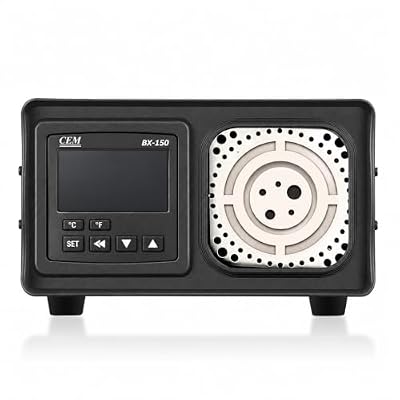
CEM BX150 Handheld Dry-Well Hi-Temperature Calibrator
The CEM BX150 is a handheld dry-block calibrator designed for high-temperature applications, ranging from 33°C to 300°C. It is a benchtop-style unit that requires 115V power and is intended for use in controlled environments. The device is designed to be rugged but contains electronics, so it should not be operated in dirty, dusty, or damp conditions.
Users must allow the unit to cool before storage if temperatures exceed 100°C. This tool is suitable for labs or workshops needing a portable high-temp reference.
- Temperature range of 33°C to 300°C
- Requires 115V power supply

INSTRUKART AI-DBC-01 Dry Block Temperature Calibrator
The INSTRUKART AI-DBC-01 is a dry-block calibrator with a range from ambient to 350°C. It includes a multifunction meter capable of measuring mA, mV, Volts, Ohms, and RTD3 (Pt 100). The unit features a graphical display with LED backlight and supports six thermocouple types. With a bath stability of ±0.05°C, it provides a stable reference for calibration labs.
This model is a good fit for facilities that need a mid-range temperature block with integrated electrical measurements.
- Temperature range up to 350°C with ±0.4°C accuracy
- Measures RTD3 (Pt 100) and electrical parameters
INSTRUKART AI-DBC-02 Dry Block Temperature Calibrator
The INSTRUKART AI-DBC-02 is a high-temperature dry-block calibrator ranging from ambient to 650°C. It shares the same multifunction measurement capabilities as its lower-range sibling, including mA, mV, Volts, Ohms, and RTD3. The unit requires 230V AC power and has a heating time of 30 to 32 minutes to reach maximum temperature.
With a bath stability of ±0.05°C, it is designed for calibration labs requiring high-temperature references. This model is suitable for industries dealing with high-heat processes.
- Temperature range up to 650°C with ±0.6°C accuracy
- Requires 230V AC power supply
Head-to-Head Comparisons
Triplett PCAL100 vs Extech PRC30: Sensor Versatility
The Triplett PCAL100 and Extech PRC30 are both handheld multifunction calibrators, but they differ in sensor support and accuracy. The Triplett unit supports 11 thermocouple types and 5 RTD types, offering broader sensor coverage. It also claims source and measure accuracy up to 0.05%. The Extech PRC30 supports eight thermocouple types and includes 24V loop power for 2-wire transmitters.
If your work involves a wide variety of RTD sensors, the Triplett may be more suitable. If you frequently test 2-wire current loops, the Extech's loop power is a key feature.
INSTRUKART AI-DBC-01 vs AI-DBC-02: Temperature Range
The INSTRUKART AI-DBC-01 and AI-DBC-02 are dry-block calibrators that share similar electrical measurement capabilities but differ in maximum temperature. The AI-DBC-01 reaches 350°C with an accuracy of ±0.4°C, while the AI-DBC-02 extends to 650°C with an accuracy of ±0.6°C. Both units require 230V AC power and feature a graphical display with LED backlight.
The choice between them depends on the maximum temperature of your calibration targets. If you only need mid-range temperatures, the 350°C model is sufficient. For high-heat applications, the 650°C model is necessary.
Fluke 714B vs ennoLogic eC370T: Loop Power and Signal Types
The Fluke 714B and ennoLogic eC370T are both process calibrators, but they approach loop testing differently. The Fluke 714B measures 4 to 20 mA signals while simultaneously sourcing a temperature signal, but it does not list a built-in loop supply in its features. The ennoLogic eC370T includes a built-in 24V loop supply, which allows it to power 2-wire transmitters directly.
The Fluke unit supports 17 thermocouple types, whereas the ennoLogic supports eight. If you need to power 2-wire devices without an external supply, the ennoLogic is the better fit. If you need extensive thermocouple type coverage, the Fluke is more versatile.
Buying Guide
Handheld vs. Dry-Block
Handheld calibrators are portable and designed for field use, allowing technicians to verify sensors in situ. Dry-block calibrators are benchtop units that provide a stable thermal environment for precise calibration. Handheld units are better for quick checks and maintenance, while dry-blocks are essential for formal calibration labs where stability and accuracy are critical.
Choose a handheld unit if you need to move between different sites or machines. Choose a dry-block if you are performing formal calibration in a controlled environment.
Sensor Type Compatibility
Ensure the calibrator supports the specific sensor types you use, such as thermocouples or RTDs. Different models support varying numbers of thermocouple types, ranging from seven to 17. Some units also support RTD types, which is crucial if you use resistance temperature detectors. Check the list of supported types in the product details to ensure compatibility with your existing sensors.
A calibrator that does not support your specific sensor type will not be useful for your workflow.
Loop Power Requirements
If you calibrate 2-wire current transmitters, look for a calibrator with a built-in loop supply. This feature allows the calibrator to power the transmitter directly, eliminating the need for an external power source. The ennoLogic eC370T and Extech PRC30 both include 24V loop power. This feature simplifies testing and reduces the number of tools needed on site.
If you only work with 4-wire sensors or thermocouples, loop power may not be a necessary feature.
Temperature Range and Accuracy
Match the calibrator's temperature range to your application. Handheld units typically cover a wide range, while dry-blocks are often specified by their maximum temperature, such as 350°C or 650°C. Accuracy is also a key factor; some units offer 0.05% accuracy, while others offer ±0.4°C or ±0.6°C.
For critical applications, higher accuracy is required. For routine checks, lower accuracy may be sufficient. Always verify the accuracy specifications against your quality requirements.
Frequently Asked Questions
What is the difference between a process calibrator and a dry-block?
A process calibrator is a handheld tool that sources and measures electrical signals and temperatures. A dry-block is a benchtop unit that provides a stable thermal environment for calibrating sensors. Process calibrators are for field use, while dry-blocks are for lab calibration.
Do I need loop power for my calibrator?
You need loop power if you calibrate 2-wire current transmitters. Loop power allows the calibrator to power the transmitter directly. If you only work with 4-wire sensors or thermocouples, loop power is not required. Check the product features for built-in loop supply.
How many thermocouple types should a calibrator support?
The number of supported types depends on your sensor inventory. Some calibrators support seven types, while others support up to 17. Ensure the calibrator supports the specific types you use, such as K, J, T, or E. More types provide greater versatility for different applications.
Can a handheld calibrator replace a dry-block?
A handheld calibrator can perform quick checks and field calibrations, but it may not provide the same stability as a dry-block. Dry-blocks are designed for formal calibration in controlled environments. For critical accuracy, a dry-block is often preferred. For routine maintenance, a handheld unit is sufficient.
This article is part of our complete guide Industrial & Scientific — browse all our comparisons and buying guides.