
Selecting the right welding wire depends on your specific project requirements, available equipment, and environmental conditions. The primary distinction in this category is between solid wire, which requires a shielding gas, and flux core wire, which is self-shielding and gasless.
Solid ER70S-6 wire is a standard for shop work and provides high tensile strength, while E71T-GS flux core wire offers portability for outdoor or rusty materials. This guide compares eight options across different diameters and spool sizes to help you match the wire to your welder and application.
Our pick: YESWELDER E71T-GS .030 Flux Core Wire. The self-shielding design eliminates the need for external gas, making it ideal for windy outdoor conditions.
Our 3 picks for different needs

YESWELDER E71T-GS .030 Flux Core Wire

The self-shielding design eliminates the need for external gas, making it ideal for windy outdoor conditions.
Read the details
Blue Demon ER70S-6 .030 Solid MIG Wire
This solid wire is commonly used for general shop applications and steel castings where fit-up may be poor.
Read the details
Lincoln Electric NR-211-MP .035 Flux Core
The .035 inch diameter is designed for all-position welding on mild steel with excellent bead appearance.
Read the detailsAll products, in detail
YESWELDER E71T-GS .030 Flux Core Wire
This self-shielding flux-cored wire is designed for outdoor and windy conditions where external shielding gas is impractical. The advanced core design includes deoxidizing agents to handle light rust and mill scale, resulting in clean welds. It is supplied on a durable ABS plastic spool and is suitable for all-position welding on carbon and low-alloy structural steel.
- Self-shielding E71T-GS flux core wire
- 0.030 inch diameter on a 2 lb spool
Blue Demon ER70S-6 .030 Solid MIG Wire
Engineered for general shop applications and steel castings, this solid wire requires a shielding gas such as CO2 or a CO2 mix. It is formulated to provide porosity-free, x-ray quality welds with high tensile strength. The 11 lb spool is a common choice for home projects and salvage work where fit-up may be poor.
- Solid ER70S-6 wire requiring shielding gas
- 0.030 inch diameter on an 11 lb spool

YESWELDER E71T-GS .030/.035 Dual Pack
This dual-specification bundle includes one 2 lb spool of .030 inch and one 2 lb spool of .035 inch E71T-GS flux core wire. The self-shielding design allows for all-position welding without external gas, making it portable for various projects. The core incorporates deoxidizing agents to ensure reliable welds through light surface contaminants.
- Dual pack of .030 and .035 inch wire
- Self-shielding E71T-GS flux core design

ARCCAPTAIN ER70S-6 .030 Solid MIG Wire
This 10 lb spool of solid ER70S-6 wire is designed for smooth feeding and stable welding parameters. It offers excellent wetting characteristics for a visually appealing bead with minimal post-weld cleanup. The wire is suitable for both novice and experienced welders, providing precise control for strong, durable welds on mild steel.
- Solid ER70S-6 wire on a 10 lb spool
- 0.030 inch diameter with smooth feedability
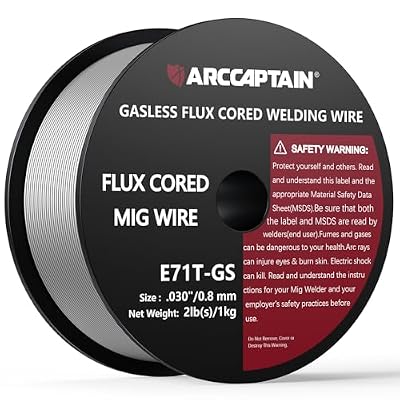
ARCCAPTAIN E71T-GS .030 Flux Core Wire
This gasless flux core wire is vacuum-packed to protect against moisture and dust. It is compatible with various welders and works well on rusty, dirty, or painted materials. The self-shielding nature makes it ideal for outdoor and high-altitude environments, supporting single and multi-pass welding for T-joints and butt welds.
- Gasless E71T-GS flux core wire
- Vacuum-packed 2 lb spool for moisture protection

PGN ER70S-6 .030 Solid MIG Wire
This 10 lb spool of solid MIG wire features high levels of silicon and manganese deoxidizers to create smooth, professional-looking beads. It is designed for low splatter performance in single or multi-pass welds. The wire is packaged with care to prevent tangles and is suitable for professional, hobbyist, or DIY projects on mild steel.
- Solid ER70S-6 wire with high deoxidizers
- 10 lb spool with 0.030 inch diameter
Lincoln Electric NR-211-MP .035 Flux Core
This pack of three spools contains .035 inch inner shield flux-core welding wire. It is designed for mild steel and all-position welding with MIG wire feed welders. The wire delivers clean welds with excellent bead appearance, making it a reliable choice for those requiring a larger diameter for heavier work.
- Inner shield flux-core wire in a pack of 3
- 0.035 inch diameter for all-position welding

HONE E71T-GS .035 Flux Core Wire
This .035 inch gasless flux core wire offers excellent penetration and smooth arc action for various welding positions. It is individually vacuum-packed for waterproof and moisture-proof storage. The wire is suitable for diverse applications from car repair to pipe welding, providing low spatter and easy slag removal.
- Gasless E71T-GS flux core wire
- 0.035 inch diameter on a 2 lb spool
Head-to-Head Comparisons
YESWELDER Flux Core vs Blue Demon Solid Wire
The choice between these two wires hinges on your shielding gas availability. The YESWELDER E71T-GS is a self-shielding flux core wire, meaning it does not require an external gas cylinder, which is advantageous for outdoor or windy environments. In contrast, the Blue Demon ER70S-6 is a solid wire that requires a shielding gas such as CO2 or a CO2 mix.
If you are working in a controlled shop environment with a gas supply, the solid wire may be preferred for its specific tensile strength properties. However, if you need portability or are welding in the field, the gasless flux core option is the more practical choice.
YESWELDER Dual Pack vs HONE .035 Flux Core
Both options are gasless E71T-GS flux core wires, but they differ in diameter and packaging. The YESWELDER dual pack includes one spool of .030 inch and one of .035 inch wire, providing versatility for different thicknesses of material. The HONE option is a single 2 lb spool of .035 inch wire that is individually vacuum-packed for waterproof and moisture-proof storage.
If you frequently switch between thin and thick materials, the dual pack offers a convenient range. If you primarily work with heavier gauge steel and prefer a single diameter, the HONE .035 wire is a focused choice.
ARCCAPTAIN vs PGN Solid ER70S-6 Wire
These two products are both 10 lb spools of .030 inch solid ER70S-6 wire, making them direct competitors for shop-based MIG welding. The ARCCAPTAIN wire emphasizes smooth feeding and stable parameters for precise control, while the PGN wire highlights high levels of silicon and manganese deoxidizers for smooth beads.
Both are designed for low splatter and are suitable for novice and experienced welders. The primary difference lies in the specific formulation focus, with PGN explicitly mentioning the deoxidizer content for bead appearance. Buyers should check current prices on the live product cards to compare the cost of these similar solid wire options.
Buying Guide
Shielding Gas Requirements
Determine if your welder is set up for gas or gasless operation. Solid wires like ER70S-6 require a shielding gas, typically CO2 or a mix, to protect the weld pool from atmospheric contamination. Flux core wires like E71T-GS are self-shielding, meaning the flux in the core creates its own gas shield.
If you do not have a gas cylinder or are working outdoors where wind can blow away gas, a self-shielding flux core wire is the necessary choice.
Wire Diameter Selection
The diameter of the wire affects the amount of heat input and the size of the weld bead. A .030 inch wire is generally suitable for thinner materials and lighter gauge work, while a .035 inch wire is better for thicker steel and heavier structural applications.
If you work with a variety of material thicknesses, a dual-specification pack or having both diameters available can provide the flexibility needed for different projects.
Material Condition and Environment
Consider the condition of the base metal and the welding environment. Flux core wires are often more tolerant of light rust, mill scale, and paint compared to solid wires. If you are welding rusty or dirty materials, a flux core wire with deoxidizing agents can produce cleaner results.
For outdoor or high-altitude environments where wind is a factor, the self-shielding nature of flux core wire is a significant advantage over gas-shielded solid wire.
Spool Size and Packaging
Spool size determines how often you need to change wire. Larger spools, such as 10 lb or 11 lb, are more efficient for long production runs or heavy use, reducing downtime. Smaller 2 lb spools are more portable and easier to store, making them suitable for hobbyists or those with limited space.
Additionally, check the packaging; vacuum-packed spools help protect the wire from moisture, which is critical for maintaining weld quality, especially with flux core wires.
Frequently Asked Questions
Can I use flux core wire in a gas-shielded MIG welder?
Yes, many gas-shielded MIG welders can use flux core wire, but you must ensure the wire feed speed and voltage settings are adjusted for the specific wire type. Using the wrong settings can lead to poor weld quality or wire feeding issues. Always consult your welder manual for compatibility.
What is the difference between ER70S-6 and E71T-GS?
ER70S-6 is a solid wire that requires external shielding gas, while E71T-GS is a flux core wire that is self-shielding. The 'S' in ER70S-6 indicates it is a solid wire, whereas the 'T' in E71T-GS indicates it is a tubular or flux core wire. They have different welding characteristics and applications.
Why is my flux core wire producing spatter?
Spatter can be caused by incorrect voltage settings, dirty base metal, or using the wrong type of wire for the material. Ensure your welder settings are appropriate for the wire diameter and type. Cleaning the base metal to remove rust and paint can also help reduce spatter and improve weld quality.
How should I store welding wire to prevent rust?
Store welding wire in a dry, cool place to prevent moisture absorption. For flux core wires, vacuum-packed spools provide additional protection. If a spool is opened, use it as soon as possible to minimize exposure to humidity. Moisture can lead to porosity and other defects in the weld.
This article is part of our complete guide Industrial & Scientific — browse all our comparisons and buying guides.
Last update on 2026-11-18 / Affiliate links / Images from Amazon Product Advertising API