
Selecting the right logarithmic amplifier or detector depends on your specific frequency requirements and how you plan to use the output signal. The modules in this comparison vary significantly in their operational bandwidth, power detection range, and output format.
Some units provide a raw DC voltage output suitable for integration into control circuits, while others offer a digital display for immediate reading. Understanding these differences helps you match the device to your test bench or production monitoring needs.
Our pick: YWBL-WH AD8317 Logarithmic Power Detector. Select this module for RSSI measurements in WLAN and WiMAX base stations where a 1 MHz to 10 GHz frequency range is required.
Our 3 picks for different needs

RF Power Meter 1-8000MHz Digital Display
Choose this unit if you need a direct digital display with 0.1 dBm resolution for straightforward power measurement without external processing.
Read the details
1-600MHz RF Signal Power Meter Logarithmic Detector
This detector is suitable for applications requiring detection up to 18 dBm and operation in the 1 MHz to 600 MHz range.
Read the details
YWBL-WH AD8317 Logarithmic Power Detector
Select this module for RSSI measurements in WLAN and WiMAX base stations where a 1 MHz to 10 GHz frequency range is required.
Read the detailsAll products, in detail
YWBL-WH AD8317 Logarithmic Power Detector
This module uses the AD8317 chip to detect RF power across a wide frequency range from 1 MHz to 10 GHz. It converts input signals into a DC voltage output that is proportional to the logarithm of the input amplitude, supporting a dynamic range of 55 dB.
The detector is suitable for RF transmitter PA set point control, level monitoring, and RSSI measurements in base stations, WLAN, and WiMAX environments. It is a good fit for engineers building test equipment or monitoring systems that require wide bandwidth coverage.
- Frequency range covers 1 MHz to 10 GHz
- Detects power from -55 dBm to 0 dBm
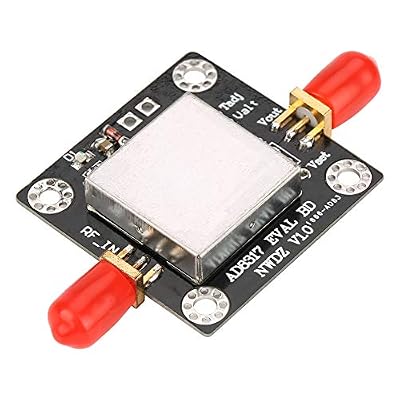
AD8317 1M-10GHz 60dB RF Power Meter
Developed using the AD8317 chip, this detector is designed for RF power detection with a frequency range of 1 MHz to 10 GHz. It detects current in the -55 dBm to 0 dBm range and converts the RF signal into a DC output. The output voltage is directly proportional to the logarithm of the input amplitude, which widens the dynamic range of the detected signal.
This module is widely used in radio frequency detection, power measurement, and environmental field strength detection, as well as in automatic gain and level control circuits.
- Frequency range spans 1 MHz to 10 GHz
- Output voltage is proportional to logarithm of input amplitude
RF Power Meter 1-8000MHz Digital Display
This RF power meter features a digital LED display for clear and straightforward data reading. It measures power in the range of -60 dBm to -5 dBm with a frequency range up to 8000 MHz. The device offers a measurement power resolution of 0.1 dBm and includes an SMA_K output interface.
Its compact and light mechanical structure makes it convenient for use in various RF detection and power measurement applications. This unit is distinct from the other modules in this list because it provides a direct digital readout rather than a raw DC voltage output.
- Includes an LED digital display with 0.1 dBm resolution
- Frequency range up to 8000 MHz
AD8317 Logarithmic Detector RF Power Meter Module
Designed with the AD8317 chip, this module is used for RF power detection with a frequency range of 1 MHz to 10 GHz. It can detect power from -55 dBm to 0 dBm, converting the RF signal into a DC voltage output. The output voltage is directly proportional to the logarithm of the input amplitude, expanding the dynamic range to 55 dB.
It is applicable in transmitter PA set point control, power monitoring in radio line transmitters, and RSSI measurements in base stations, WLAN, and WiMAX systems.
- Dynamic range reaches 55 dB
- Suitable for RSSI measurements in WLAN and WiMAX

Hilitand AD8317 Logarithmic Detector RF Power Meter
This logarithmic detector adopts the AD8317 chip for RF power detection. It can detect power in the -55 dBm to 0 dBm range, converting the RF signal into a DC voltage output. The output voltage is directly proportional to the logarithm of the input amplitude, which expands the dynamic range of the detected signal to 55 dB.
It is widely used in radio frequency detection, power measurement, and environmental field strength detection. The module can also serve as part of automatic gain control and automatic level control systems.
- Frequency range covers 1 MHz to 10000 MHz
- Dynamic range reaches 55 dB
1-600MHz RF Signal Power Meter Logarithmic Detector
This detector is used for RF signal power detection in the frequency range between 1 MHz and 600 MHz. It can detect an RF signal of power from -74 dBm to 18 dBm and convert the RF signal into a DC voltage output. The output voltage is proportional to the logarithm of the input signal range.
It is widely used for RF signal detection, signal power measurement, and environment field strength detection. This unit can be made into a 1 mW to 1 kW RF power meter after appropriate transformation, making it suitable for higher power applications than the other modules listed.
- Frequency range limited to 1 MHz to 600 MHz
- Detects power from -74 dBm to 18 dBm
Head-to-Head Comparisons
YWBL-WH AD8317 vs 1-600MHz Detector: Bandwidth vs Power Range
The YWBL-WH AD8317 module offers a much wider frequency range, covering 1 MHz to 10 GHz, compared to the 1-600MHz detector which is limited to 1 MHz to 600 MHz. However, the 1-600MHz detector has a significantly wider power detection range, capable of handling signals from -74 dBm to 18 dBm, whereas the YWBL-WH unit detects from -55 dBm to 0 dBm.
If your application involves high-frequency signals in the microwave range, the YWBL-WH is the appropriate choice. If you are working with lower frequency signals and need to measure higher power levels up to 18 dBm, the 1-600MHz detector is better suited for that task.
Digital Display Meter vs AD8317 Module: Output Format
The primary difference between these two products is their output format. The RF Power Meter with digital display provides an LED screen that shows the measurement directly, offering a resolution of 0.1 dBm. This makes it convenient for quick checks and standalone use. In contrast, the AD8317 1M-10GHz module outputs a DC voltage proportional to the logarithm of the input amplitude.
This raw output is designed for integration into larger systems, such as automatic gain control circuits, where the voltage signal needs to be processed by other electronics. Choose the digital meter for immediate visual feedback and the AD8317 module for system integration.
AD8317 Module vs Hilitand AD8317: Application Focus
Both the AD8317 Logarithmic Detector and the Hilitand AD8317 use the same AD8317 chip and share a similar frequency range of 1 MHz to 10 GHz and a dynamic range of 55 dB. The main distinction lies in the specific application examples provided. The AD8317 Logarithmic Detector explicitly mentions use in transmitter PA set point control and RSSI measurements in base stations, WLAN, and WiMAX.
The Hilitand version emphasizes general radio frequency detection, power measurement, and environmental field strength detection. For buyers specifically targeting wireless communication base station monitoring, the AD8317 Logarithmic Detector's listed applications may be more directly relevant.
Buying Guide
Frequency Range Requirements
Determine the highest frequency you need to measure. Most modules in this list cover up to 10 GHz, which is suitable for most modern RF applications. However, one detector is limited to 600 MHz. If your work involves microwave frequencies above 600 MHz, you must select a unit with a 10 GHz range.
Check your specific signal source to ensure the detector's bandwidth covers your operating frequency.
Power Detection Range
Consider the minimum and maximum power levels you expect to encounter. The standard AD8317-based modules detect from -55 dBm to 0 dBm. The 1-600MHz detector extends this range to -74 dBm on the low end and 18 dBm on the high end. If you need to measure very weak signals or higher power levels, the 1-600MHz detector offers a wider dynamic range in terms of absolute power, despite its narrower frequency bandwidth.
Output Type and Integration
Decide whether you need a standalone reading or a signal for further processing. The digital display meter provides a direct readout, which is ideal for quick verification. The other modules output a DC voltage. This voltage output is necessary if you are building a control loop, such as automatic gain control, or if you need to feed the measurement into a microcontroller or data acquisition system.
Resolution and Accuracy
For the digital display meter, the resolution is specified as 0.1 dBm. For the DC output modules, the resolution is determined by the logarithmic relationship between input power and output voltage. If your application requires precise digital readings without external conversion, the display meter is the only option in this list that provides this directly.
For integrated systems, the DC output allows for high-resolution measurement depending on your analog-to-digital converter settings.
Frequently Asked Questions
What is the difference between a logarithmic detector and a linear detector?
A logarithmic detector produces an output voltage that is proportional to the logarithm of the input power. This allows it to handle a wide dynamic range, such as 55 dB, with a manageable output voltage swing. Linear detectors produce an output proportional to the input power, which can saturate at high power levels or become too small to measure accurately at low levels.
Can these modules be used for automatic gain control?
Yes, several of the modules listed are explicitly described as suitable for use as part of automatic gain control and automatic level control systems. The DC voltage output from the logarithmic detector can be used to adjust the gain of an amplifier to maintain a constant output level despite variations in input signal strength.
What is the frequency range of the 1-600MHz detector?
The 1-600MHz detector is designed for RF signal power detection in the frequency range between 1 MHz and 600 MHz. This makes it suitable for lower frequency applications, such as certain AM/FM radio bands or industrial, scientific, and medical (ISM) bands, but it is not suitable for microwave frequencies above 600 MHz.
Do these modules require external power?
The product descriptions do not specify the power supply requirements for these modules. You should check the specific datasheet or product manual for the voltage and current requirements before integrating them into your system. Most RF detector modules require a DC power supply to operate the internal circuitry.
This article is part of our complete guide Electronics — browse all our comparisons and buying guides.
Last update on 2026-11-18 / Affiliate links / Images from Amazon Product Advertising API