
Selecting the right reaction kettle depends on the volume of your experiment and the number of attachments required. The eight options in this comparison range from small 100ml jacketed flasks to large 5L four-neck reactors. Each vessel is constructed from borosilicate glass, ensuring thermal stability for laboratory use.
The primary differences lie in capacity, neck count, and base shape. Round bottom flasks require stands, while flat bottom vessels can sit on surfaces. Neck count determines how many components, such as condensers or thermometers, can be attached simultaneously. Reviewing these specifications helps you match the vessel to your specific experimental needs.
Our 3 picks for different needs

Deschem 5000ml 4-Neck Round Bottom Reactor
The 5L capacity and four-neck design support large-scale processes requiring multiple attachments.
Read the details
Deschem 100ml Single Neck Jacketed Flask
The 100ml jacketed design allows for precise temperature management in small batches.
Read the details
Deschem 1000ml Flat Bottom Spheroidal Reactor
The flat bottom spheroidal shape provides a stable base for surface-mounted reaction setups.
Read the detailsAll products, in detail

Dinglab 500ml 1-Neck Round Bottom Reactor
This Dinglab vessel is a 500ml round bottom flask with a single 24/40 neck. It is constructed from Borosilicate Glass 3.3, which has an annealing point of 560°C and a softening point of 820°C. The package includes a lid and a steel clamp for secure mounting.
This configuration is suitable for simple reaction setups where only one attachment point is required. The linear coefficient of expansion is 32×10-7/°C, indicating standard thermal stability for glassware.
- 500ml capacity with a single 24/40 neck
- Includes lid and steel clamp
Deschem 5000ml 4-Neck Round Bottom Reactor
The Deschem 5L reactor is a large-capacity vessel with four 24/40 necks. It is made from Borosilicate Glass 3.3 with a softening point of 820°C. This four-neck design allows for multiple simultaneous attachments, such as condensers, thermometers, and feed lines. The included lid and steel clamp support secure installation in larger laboratory environments.
The high capacity makes it appropriate for bulk reaction processes that require significant volume.
- 5000ml capacity with four 24/40 necks
- Borosilicate Glass 3.3 construction

Deschem 1000ml 4-Neck Round Bottom Reactor
This 1L Deschem reactor features four 24/40 necks on a round bottom base. It is crafted from Borosilicate Glass 3.3, offering a softening point of 820°C. The four-neck configuration provides flexibility for complex experimental setups requiring multiple ports. The vessel comes with a lid and a steel clamp for mounting.
It is a standard choice for mid-scale reactions that need more attachment points than a single or two-neck flask.
- 1000ml capacity with four 24/40 necks
- Includes lid and steel clamp

Deschem 1000ml 2-Neck Round Bottom Reactor
The Deschem 1L two-neck reactor is a round bottom vessel with two 24/40 ports. It is made from Borosilicate Glass 3.3 with a linear coefficient of expansion of 32×10-7/°C. This configuration is ideal for setups requiring two attachments, such as a condenser and a thermometer.
The package includes a 2-neck lid and a steel clamp. It offers a balance between simplicity and functionality for standard laboratory reactions.
- 1000ml capacity with two 24/40 necks
- Includes 2-neck lid and steel clamp

DONLAB 1000ml Cylindrical Round Bottom Flask
This DONLAB replacement body is a 1L cylindrical round bottom flask. It features a heavy wall design with a 150mm standard flat flange ground glass outside diameter. The inner diameter of the flange is approximately 10cm, and the edge thickness is about 9mm. This item is sold as a body only, without a lid or clamp.
It is suitable for users who need a specific flange size for existing reactor assemblies.
- 1000ml capacity with 150mm flat flange OD
- Sold as body only without lid or clamp
Deschem 1000ml Flat Bottom Spheroidal Reactor
This Deschem vessel is a 1L spheroidal reaction kettle with a flat bottom. It is made from Borosilicate Glass 3.3 with a softening point of 820°C. The flange outside diameter is 15cm. Unlike round bottom flasks, the flat bottom design allows the vessel to sit stably on a surface without a stand.
This makes it suitable for setups where a stable base is preferred over a suspended round bottom configuration.
- 1000ml capacity with flat bottom design
- 15cm flange outside diameter
Deschem 100ml Single Neck Jacketed Flask
The Deschem 100ml jacketed flask is a small, single-neck vessel with a 24/40 connection. It is constructed from G3.3 Borosilicate Glass with a softening point of 820°C. The jacketed design allows for temperature control via fluid circulation. This small capacity is appropriate for pilot-scale reactions or small batch experiments.
It is a compact option for laboratories requiring precise thermal management in a small volume.
- 100ml capacity with jacketed design
- Single 24/40 neck
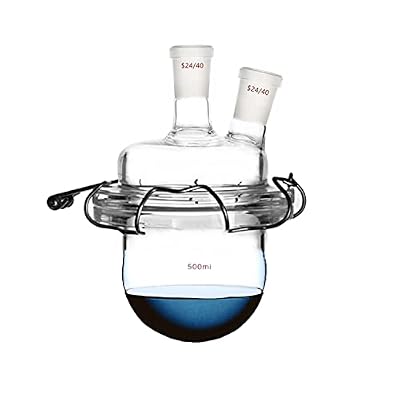
Deschem 500ml 2-Neck Round Bottom Reactor
This 500ml Deschem reactor has two 24/40 necks on a round bottom base. It is made from Borosilicate Glass 3.3 with an annealing point of 560°C. The two-neck configuration supports two attachments, such as a condenser and a stirrer. The package includes a 2-neck lid and a steel clamp.
It is a versatile mid-size option for reactions that require more ports than a single-neck flask but less than a four-neck setup.
- 500ml capacity with two 24/40 necks
- Includes 2-neck lid and steel clamp
Head-to-Head Comparisons
Deschem 1L 4-Neck vs 2-Neck Reactor
Both Deschem 1L reactors are made from Borosilicate Glass 3.3 and include a steel clamp. The main difference is the number of necks. The four-neck model offers more attachment points, allowing for complex setups with multiple components. The two-neck model is simpler and may be sufficient for basic reactions requiring only a condenser and a thermometer.
Choose the four-neck version if your experiment requires multiple simultaneous attachments. Choose the two-neck version for simpler setups where fewer ports are needed.
Dinglab 500ml 1-Neck vs Deschem 500ml 2-Neck
These two 500ml round bottom reactors differ in neck count and brand. The Dinglab model has a single 24/40 neck, while the Deschem model has two. Both are made from Borosilicate Glass 3.3 and include a lid and steel clamp. The single-neck Dinglab flask is suitable for simple reactions with one attachment.
The two-neck Deschem flask allows for two attachments, providing more flexibility. If your setup requires only one port, the Dinglab option is a straightforward choice. If you need two ports, the Deschem model is more appropriate.
DONLAB Cylindrical vs Deschem Spheroidal Flat Bottom
Both 1L vessels have flat bottoms, but their shapes and flange specifications differ. The DONLAB flask is cylindrical with a 150mm flange OD and is sold as a body only. The Deschem flask is spheroidal with a 15cm flange OD and is described as a glass reactor flask.
The DONLAB option is a replacement body, so you must have a compatible lid and clamp. The Deschem option is a complete vessel. Choose the DONLAB flask if you need a specific cylindrical shape for an existing assembly. Choose the Deschem flask if you need a complete spheroidal vessel.
Buying Guide
Match Neck Count to Attachments
The number of necks on a reaction kettle determines how many components you can attach. A single-neck flask is suitable for simple setups with one attachment, such as a condenser. Two-neck flasks allow for two attachments, such as a condenser and a thermometer. Four-neck flasks provide maximum flexibility for complex experiments.
Consider the number of components your experiment requires before selecting a vessel. If you need to attach multiple devices, a four-neck reactor is the appropriate choice. For simpler setups, a single or two-neck flask may be sufficient. Precision dispensing devices often require specific port configurations, so ensure your vessel has the necessary necks.
Consider Capacity for Your Batch Size
The capacity of the reaction kettle should match the volume of your experiment. Small 100ml flasks are suitable for pilot-scale reactions or small batches. Mid-size 500ml and 1L reactors are common for standard laboratory experiments. Large 5L reactors are appropriate for bulk processes. Do not overfill the vessel, as this can affect reaction efficiency and safety.
Choose a capacity that is slightly larger than your maximum expected volume. This ensures adequate headspace for gas evolution or mixing. Check current prices on the live product cards when cost matters for your specific capacity needs.
Choose Between Round and Flat Bottoms
Round bottom flasks require a stand or clamp for support. They are common in traditional laboratory setups. Flat bottom vessels can sit directly on a surface, providing stability without a stand. The choice depends on your laboratory setup and preferences. Round bottom flasks are often used with clamps for secure mounting.
Flat bottom vessels are convenient for surface-mounted setups. Consider the stability and mounting options available in your laboratory. If you have a stand, a round bottom flask is a standard choice. If you prefer a stable base, a flat bottom vessel is appropriate.
Verify Glass Type and Thermal Properties
All listed vessels are made from borosilicate glass, which offers good thermal stability. The annealing point is typically 560°C, and the softening point is 820°C. The linear coefficient of expansion is 32×10-7/°C. These properties ensure the glass can withstand temperature changes during reactions. Verify that the glass type meets your laboratory's safety standards.
Borosilicate glass is resistant to thermal shock, making it suitable for heating and cooling cycles. Ensure the vessel is compatible with your heating and cooling methods. Liquid handling and vacuum systems often require specific glass types, so confirm compatibility with your equipment.
Frequently Asked Questions
What is the difference between a 1-neck and a 4-neck reactor?
A 1-neck reactor has one attachment point, suitable for simple setups. A 4-neck reactor has four attachment points, allowing for multiple components like condensers and thermometers. Choose based on the number of attachments your experiment requires.
Are these reaction kettles suitable for heating?
Yes, they are made from borosilicate glass with a softening point of 820°C. This allows them to withstand high temperatures. Always follow laboratory safety guidelines when heating glassware to ensure proper handling and prevent thermal shock.
Do the Deschem reactors come with clamps?
Yes, the Deschem round bottom reactors listed include a steel clamp and a lid. This allows for secure mounting in a laboratory stand. The DONLAB cylindrical flask is sold as a body only, so you must provide your own clamp and lid.
Can I use a flat bottom reactor in a standard stand?
Flat bottom reactors are designed to sit on a surface. They may not fit securely in a standard round bottom stand. If you need to suspend the vessel, a round bottom flask is the appropriate choice for use with a clamp.
This article is part of our complete guide Toys & Games — browse all our comparisons and buying guides.
Last update on 2026-11-21 / Affiliate links / Images from Amazon Product Advertising API