
Selecting the right science lab stains depends on the specific biological structures you need to visualize and the techniques you employ. Whether you are differentiating bacteria in a microbiology course or visualizing DNA fragments in a molecular biology lab, the choice of reagent impacts the clarity and safety of your results.
This guide compares eight options from the ALDON and Innovating Science lines, ranging from single-bottle solutions to comprehensive multi-bottle kits. We examine the specific applications, volumes, and safety features of each product to help you match the stain to your experimental needs.
Our 3 picks for different needs

ALDON Complete Microscope Slide Stains Kit
The 19-bottle set covers vital, bacterial, and Gram staining techniques in one package.
Read the details
Innovating Science DNA Stain 100mL
This DNA stain offers high-contrast visualization without the need for UV light exposure.
Read the details
Innovating Science Gram's Stain Kit – Large
This kit includes all necessary reagents and instructions for the Gram staining protocol.
Read the detailsAll products, in detail

ALDON Methylene Blue 1% Aqueous Solution
This 1 fl oz (30mL) dropper bottle contains a 1% aqueous methylene blue solution, a versatile staining agent used in microscopy, histology, microbiology, and bacteriology. It is designed for easy handling and preparation, with directions for safe storage included. The solution aids in the visualization and differentiation of cellular structures and microorganisms, making it a standard tool for biological investigations.
It is part of the Curated Chemical Collection.
- 1% aqueous solution in a 30mL dropper bottle
- Used for microscopy, histology, and microbiology

Innovating Science SK-5 Bacteria Stain Set
The SK-5 kit provides a five-pack of microscopy stains specifically for bacterial identification. It is designed for simplified transport and handling, shipping under the DOT small quantity exemption for domestic highway or rail transport. This logistical feature supports straightforward and compliant handling during ground shipping, which is beneficial for educational institutions and labs that need to receive multiple reagents in a single shipment.
- 5-pack of bacteria microscopy stains
- Ships under DOT small quantity exemption
Innovating Science Gram's Stain Kit – Large
This large kit includes the essential components for the Gram staining procedure, including dilute Lugol's, crystal violet stain, safranin 0 (1% aqueous), and ethanol. It comes with an instruction manual and a safety data sheet to guide users through the process. The kit is designed to help users develop an understanding of the principles behind Gram staining, making it a practical component for many lab and educational applications where bacterial differentiation is required.
- Includes crystal violet, safranin, Lugol's, and ethanol
- Comes with an instruction manual and SDS
ALDON Complete Microscope Slide Stains Kit
This comprehensive set contains 19 chemicals in 30mL dropper bottles, combining three distinct stain sets: Vital Stains (7), Bacteria Stains (5), and Gram Stains (7). It includes a multi-page instruction manual with procedures for each technique and a set of Safety Data Sheets. The chemicals are manufactured in the United States and come in convenient dropper bottles for controlled dispensing.
This kit is suitable for users who need a wide variety of staining techniques for living and fixed cells.
- Contains 19 chemicals in 30mL dropper bottles
- Includes Vital, Bacteria, and Gram stain sets

ALDON Aceto-Orcein Biostain 2% Solution
This 30mL laboratory-grade solution is a chromosome stain and fixative used in microscopy to visualize chromosomes in cells undergoing mitosis. The bottle features a GHS-compliant label with safety and storage information, and the cap color is coded to match storage requirements for visual reference. It is part of the Curated Chemical Collection by Innovating Science and is manufactured in the United States.
This reagent is specifically targeted at cytology and cell division studies.
- 2% solution for chromosome visualization
- Features GHS-compliant labeling and color-coded caps
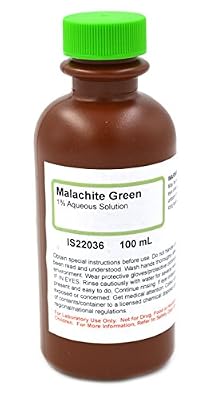
ALDON 1% Malachite Green Stain 100mL
This 100mL bottle of 1% malachite green stain is a general-purpose reagent for lab and educational use. It is commonly used as a staining agent in microbiology labs and classrooms. The bottle includes instructions for safe storage printed directly on the label, and an MSDS is available upon request.
The larger volume compared to standard 30mL bottles may be suitable for high-volume instructional settings or ongoing research projects.
- 100mL volume of 1% solution
- General purpose stain for microbiology
Innovating Science DNA Stain 100mL
This 100mL DNA stain is designed for gel electrophoresis, DNA visualization, and molecular biology research. It provides high-contrast blue bands for easy analysis of DNA fragments and does not require UV light for visualization, which eliminates exposure risks associated with ethidium bromide. It is suitable for high school, college, and university labs, as well as forensic applications.
The formulation is compatible with both real-time and post-run staining methods.
- 100mL volume for gel electrophoresis
- Does not require UV light for visualization

Innovating Science Crystal Violet Powder 25g
This 25g quantity of lab-grade crystal violet is a cationic triphenylmethane dye used in microbiology, biological staining, and analytical chemistry. It binds to peptidoglycan in bacterial cell walls for Gram staining and stains nuclei in histology studies. It also functions as a pH indicator in acid-base titrations and is applied in DNA staining for agarose gel electrophoresis.
The powder format allows for the preparation of specific concentrations required for various protocols.
- 25g lab-grade powder
- Used for Gram staining, histology, and pH indication
Head-to-Head Comparisons
Methylene Blue vs Malachite Green: Volume and Application
Both ALDON Methylene Blue and Malachite Green are general-purpose stains used in microbiology and education. The Methylene Blue is provided in a 1 fl oz (30mL) dropper bottle, which is suitable for smaller-scale experiments or introductory classes. In contrast, the Malachite Green is available in a 100mL bottle, offering a larger volume that may be more practical for high-volume instructional settings or ongoing research projects.
While both are aqueous solutions, the Malachite Green listing emphasizes its general purpose nature for any microbiology lab, whereas the Methylene Blue highlights its versatility across microscopy, histology, and bacteriology. Buyers should choose based on the volume required for their specific curriculum or research timeline.
Gram Stain Kit vs Complete Slide Stains Kit
The Gram's Stain Kit – Large focuses specifically on the Gram staining procedure, including crystal violet, safranin, Lugol's, and ethanol. It is ideal for users who primarily need to differentiate Gram-positive and Gram-negative bacteria. The Complete Microscope Slide Stains Kit, however, is a broader collection containing 19 chemicals across three sets: Vital, Bacteria, and Gram.
If your lab requires only Gram staining, the dedicated kit is a focused choice. If you need to perform a variety of staining techniques on living and fixed cells, the Complete Kit provides the necessary reagents in 30mL dropper bottles, saving the effort of purchasing individual sets.
Both include instruction manuals and safety data sheets.
DNA Stain Solution vs Crystal Violet Powder
For visualizing DNA in agarose gel electrophoresis, the Innovating Science DNA Stain is a ready-to-use 100mL solution that does not require UV light. This is a significant safety advantage for educational settings. The Crystal Violet Powder, a 25g lab-grade reagent, can also be used for DNA staining but requires the user to prepare the solution.
The powder format offers flexibility for creating specific concentrations and is also used for Gram staining and pH indication. If you need a convenient, safe, and ready-to-use option for DNA visualization, the liquid DNA stain is the direct choice. If you need a versatile dye for multiple applications including histology and analytical chemistry, the powder offers more utility.
Buying Guide
Matching Stains to Microscopy Techniques
Different biological structures require different staining agents to become visible under a microscope. Methylene Blue is a versatile agent for general cellular structures, while Aceto-Orcein is specifically designed for visualizing chromosomes during mitosis. When selecting a stain, identify the primary target of your observation. For bacterial identification, Gram stains like Crystal Violet and Safranin are essential.
For molecular biology, specific DNA stains are required. Ensuring the stain matches the technique prevents wasted reagents and ensures clear results.
Considering Volume and Dispensing Needs
The volume of the reagent bottle should align with your usage frequency. Single 30mL dropper bottles are common for standard kits and are easy to handle for small-scale experiments. Larger 100mL bottles, such as those for Malachite Green and DNA Stain, are better suited for high-volume classroom use or long-term research projects.
Dropper bottles offer controlled dispensing, which is crucial for precise staining. If you are setting up a new lab, consider whether you need individual small bottles for variety or larger volumes for consistency.
Safety and Handling Requirements
Safety features are a critical consideration, especially in educational environments. The DNA Stain is highlighted for not requiring UV light, which reduces exposure risks. Other products include GHS-compliant labels and color-coded caps for storage reference. The SK-5 Bacteria Stain Set is designed for simplified transport under DOT exemptions, which is useful for logistics.
Always review the Safety Data Sheets (SDS) provided with kits to ensure your facility can handle the specific chemicals safely. Proper storage and handling protocols are essential for maintaining reagent integrity and user safety.
Choosing Between Kits and Individual Reagents
Buying a comprehensive kit like the Complete Microscope Slide Stains Kit can simplify inventory management by providing multiple stains in one package. This is ideal for new labs or classrooms that need to cover a wide range of techniques. However, if you only need one specific stain, such as Methylene Blue or Aceto-Orcein, purchasing the individual bottle may be more efficient.
Kits often include instruction manuals that guide users through procedures, which is beneficial for students. Evaluate your curriculum or research needs to decide if a broad kit or specific individual reagents better serve your goals.
Frequently Asked Questions
What is the difference between a stain and a fixative?
A stain adds color to biological structures to enhance visibility under a microscope, while a fixative preserves the structure of the sample. Some products, like the Aceto-Orcein Biostain, function as both a stain and a fixative, allowing for visualization and preservation in a single step.
Can I use these stains in a high school classroom?
Yes, many of these products are designed for educational use. The DNA Stain is specifically noted as suitable for high school, college, and university labs. Kits often include instruction manuals and safety data sheets to support safe and effective classroom implementation.
Do I need UV light to use the DNA Stain?
No, the Innovating Science DNA Stain is formulated to provide high-contrast blue bands without requiring UV light for visualization. This eliminates the exposure risks associated with traditional ethidium bromide methods, making it a safer option for educational settings.
How should I store these laboratory stains?
Most of these products come with instructions for safe storage printed on the bottle or in the included manual. The Aceto-Orcein bottle features color-coded caps that match storage requirements. Always follow the specific storage guidelines provided in the Safety Data Sheet for each reagent.
This article is part of our complete guide Toys & Games — browse all our comparisons and buying guides.
Last update on 2026-11-18 / Affiliate links / Images from Amazon Product Advertising API