
Selecting the right coated microplate depends on the specific biological requirements of your cell culture experiments. The three options listed here differ in well count, coating type, and optical properties, each serving distinct experimental needs.
The Greiner Bio-One models offer 24-well formats with specific protein or polymer coatings, while the Corning model provides a 384-well high-density format with black walls for optical clarity. Understanding these differences helps you match the plate to your assay design and instrumentation.
Our pick: Greiner Bio-One 662950 Collagen Type I 24-Well Plate. Choose this Greiner Bio-One plate when your protocol specifically requires a Collagen Type I coating for cell adhesion in a 24-well format.
Our 3 picks for different needs
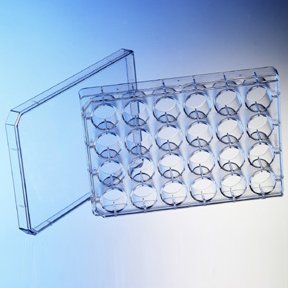
Greiner Bio-One 662950 Collagen Type I 24-Well Plate
Choose this Greiner Bio-One plate when your protocol specifically requires a Collagen Type I coating for cell adhesion in a 24-well format.
Read the details
Corning 4596 Fibronectin 384-Well Black Plate
Select this Corning plate for high-density assays where low background fluorescence and robotic compatibility are essential for accurate optical readings.
Read the details
Greiner Bio-One 662940 Poly-D-Lysine 24-Well Plate
Pick this Greiner Bio-One plate when a Poly-D-Lysine coating is preferred for cell attachment in a standard 24-well configuration.
Read the detailsAll products, in detail
Greiner Bio-One 662950 Collagen Type I 24-Well Plate
The Greiner Bio-One 662950 is a 24-well polystyrene microplate designed for cell culture applications requiring a specific extracellular matrix environment. This model features a flat bottom and a chimney-style lid, which helps maintain a controlled atmosphere during incubation. The wells are coated with Collagen Type I, a protein that supports the adhesion and growth of many mammalian cell types.
The plate is manufactured in the United States and sold in a pack of 50 units. This configuration suits researchers who need a moderate well count for parallel experiments while ensuring cells attach to a biologically relevant surface. The flat bottom design facilitates consistent optical readings and microscopic observation.
Buyers should consider this option when Collagen Type I is the preferred substrate for their specific cell line.
- Coated with Collagen Type I for cell adhesion
- 24-well format with flat bottom and chimney-style lid
- Polystyrene construction manufactured in the United States
Corning 4596 Fibronectin 384-Well Black Plate
The Corning 4596 is a high-density 384-well microplate featuring a flat clear bottom and a low flange design. This plate is coated with Fibronectin, a glycoprotein that promotes cell attachment and spreading. The black walls provide low background fluorescence and minimal light scatter, which is critical for reducing crosstalk in high-throughput screening.
The optically clear flat well bottom permits direct microscopic viewing and is compatible with both top and bottom reading instruments. The low flange design supports barcode customization and robotic handling, making it suitable for automated laboratory workflows. This sterile plate is sold in a pack of 100 units.
Researchers performing high-throughput assays or requiring precise optical measurements should evaluate this model for its specific optical properties and high well count.
- 384-well format with black walls for low background fluorescence
- Fibronectin-coated surface with optically clear flat bottom
- Low flange design for robotic handling and barcode customization
Greiner Bio-One 662940 Poly-D-Lysine 24-Well Plate
The Greiner Bio-One 662940 is a 24-well polystyrene microplate that offers an alternative coating to the Collagen Type I variant. This model is coated with Poly-D-Lysine, a cationic polymer that provides a positively charged surface for cell attachment. Like its sibling model, it features a flat bottom and a chimney-style lid, ensuring a controlled environment for cell culture.
The plate is manufactured in the United States and available in a pack of 50 units. This option is suitable for experiments where a general-purpose, positively charged substrate is preferred over a specific protein coating. The flat bottom design allows for consistent imaging and reading.
Buyers should select this plate when Poly-D-Lysine is the required surface treatment for their specific experimental protocol.
- Coated with Poly-D-Lysine for general cell attachment
- 24-well format with flat bottom and chimney-style lid
- Polystyrene construction manufactured in the United States
Head-to-Head Comparisons
Greiner Bio-One 24-Well vs Corning 384-Well: Density and Coating
The Greiner Bio-One 662950 and the Corning 4596 differ significantly in well count and coating chemistry. The Greiner plate offers 24 wells coated with Collagen Type I, suitable for lower-throughput experiments requiring a specific extracellular matrix component. In contrast, the Corning plate provides 384 wells coated with Fibronectin, designed for high-throughput screening.
The Corning plate also features black walls to reduce background fluorescence, whereas the Greiner plate uses standard polystyrene walls. The data does not establish which coating is superior for all cell types, as the choice depends on the specific biological interaction required. Researchers needing high-density optical assays should consider the Corning model, while those requiring Collagen Type I in a lower density format should look at the Greiner option.
Greiner Bio-One Collagen vs Poly-D-Lysine: Coating Choice
Both the Greiner Bio-One 662950 and 662940 are 24-well polystyrene plates with flat bottoms and chimney-style lids, manufactured in the United States. The primary distinction lies in the surface coating. The 662950 model is coated with Collagen Type I, a protein that mimics the natural extracellular matrix and supports the growth of many mammalian cells.
The 662940 model is coated with Poly-D-Lysine, a cationic polymer that provides a positively charged surface for general cell attachment. The choice between these two depends on the specific cell line and experimental protocol. The supplied data does not indicate a performance difference in cell growth rates, so the decision should be based on the required surface chemistry for your specific assay.
Corning 384-Well vs Greiner Bio-One 24-Well: Optical and Format
The Corning 4596 and the Greiner Bio-One 662940 serve different experimental scales and optical requirements. The Corning plate is a 384-well format with black walls, which minimizes light scatter and crosstalk, making it ideal for fluorescence-based high-throughput screening. It also features a low flange design for robotic handling.
The Greiner plate is a 24-well format with standard polystyrene walls and a chimney-style lid, suitable for lower-throughput experiments where atmospheric control is prioritized. The Corning plate is sterile and has an optically clear flat bottom for direct microscopic viewing. The data does not establish a universal preference, as the choice depends on whether you need high-density optical precision or a standard culture format with a specific polymer coating.
Buying Guide
Matching Coating to Cell Type
The choice of coating is the primary factor in selecting a coated microplate. The Greiner Bio-One 662950 offers a Collagen Type I coating, which is often preferred for cells that require a protein-based substrate for adhesion and differentiation. The Greiner Bio-One 662940 provides a Poly-D-Lysine coating, a general-purpose cationic surface that supports the attachment of many cell types through electrostatic interactions.
The Corning 4596 features a Fibronectin coating, another protein-based substrate that promotes cell spreading.
Researchers should select the coating that matches the specific biological requirements of their cell line. For example, if your protocol specifies a collagen environment, the Greiner 662950 is the appropriate choice. If a general positive charge is sufficient, the Greiner 662940 may be suitable. For high-throughput assays requiring fibronectin, the Corning 4596 is the indicated option.
Consider the specific interaction mechanism required by your cells when making this selection.
Well Count and Throughput
The well count determines the scale of your experiment. The two Greiner Bio-One models offer 24-well formats, which are suitable for lower-throughput experiments where individual well observation or manual handling is common. The Corning 4596 offers a 384-well format, designed for high-throughput screening where many samples need to be processed simultaneously.
If your laboratory workflow involves manual pipetting and detailed microscopic observation of individual wells, the 24-well plates may be more practical. If your workflow involves automated liquid handling and high-density assays, the 384-well plate is the appropriate choice. The Corning plate's low flange design specifically supports robotic handling, which is a key consideration for automated laboratories.
Optical Properties and Instrument Compatibility
The optical properties of the plate walls and bottom are critical for fluorescence and absorbance readings. The Corning 4596 features black walls, which provide low background fluorescence and minimal light scatter, reducing crosstalk between wells. This is essential for high-sensitivity optical assays. The plate also has an optically clear flat bottom, permitting direct microscopic viewing and compatibility with both top and bottom reading instruments.
The Greiner Bio-One plates use standard polystyrene walls, which may have higher background fluorescence compared to black-walled plates. The flat bottom design on all three plates supports consistent optical readings. If your assay relies on high-sensitivity fluorescence detection, the Corning 4596 is the better fit due to its specific optical design.
Lid Style and Atmospheric Control
The lid style affects the atmospheric conditions within the plate. The Greiner Bio-One models feature a chimney-style lid, which allows for gas exchange while maintaining a controlled environment. This is beneficial for cell culture applications where CO2 and humidity levels need to be regulated. The Corning 4596 includes a lid, but the specific style is not detailed in the supplied data beyond its presence.
For experiments requiring strict atmospheric control, the chimney-style lid of the Greiner plates may be advantageous. The Corning plate's low flange design is optimized for robotic handling and barcode customization, which may be more important than lid style in automated workflows. Consider the specific atmospheric requirements of your cell culture when selecting a lid style.
Frequently Asked Questions
What is the difference between Collagen Type I and Poly-D-Lysine coatings?
Collagen Type I is a protein that mimics the natural extracellular matrix, supporting specific cell adhesion and growth. Poly-D-Lysine is a cationic polymer that provides a positively charged surface for general cell attachment through electrostatic interactions. The choice depends on the specific biological requirements of your cell line.
Are these microplates sterile?
The Corning 4596 is explicitly listed as sterile. The supplied data for the Greiner Bio-One models does not specify sterility status. Researchers should verify the sterility of the Greiner plates through the manufacturer's documentation if aseptic technique is required for their experiments.
Can the Corning 4596 be used with robotic systems?
Yes, the Corning 4596 features a low flange design that is specifically intended for barcode customization and robotic handling. This design facilitates integration with automated liquid handling systems and high-throughput screening platforms.
What is the well count for each plate?
The Greiner Bio-One 662950 and 662940 are both 24-well plates. The Corning 4596 is a 384-well plate. The well count determines the throughput of your experiment, with 384-well plates suitable for high-throughput screening and 24-well plates for lower-throughput studies.
This article is part of our complete guide Toys & Games — browse all our comparisons and buying guides.
Last update on 2026-11-21 / Affiliate links / Images from Amazon Product Advertising API